Author Archives: lauholder

Lucy’s Marathon

When my alarm went off this morning, I didn’t want to wake up. I thought of several reasons to stay in bed.  But one reason finally compelled me to get out of bed and lace up my shoes–my grandmother.
Image

My grandma Lucy died the summer before I started seminary, just two months before Jay and I were married.  The quintessential church lady, grandma was a Sunday school teacher, Bible study leader, youth coordinator, president of the United Methodist Women, and was once given a Lay Pastoral Care Award.  So when grandma reminded us repeatedly that she prayed for each one of us by name every night, even after Alzheimer’s started to claim her brain, we believed her.  I remembered this right around mile 4 of my run this morning as the sun finally peaked through a series of sky scrapers in lower Manhattan, spilling light onto my path and my face.  Even after my grandmother’s death, I still feel her prayers.

Just as my grandmother’s prayers continue to touch my life, so does her legacy with Alzheimer’s disease.  When my grandmother was living, she shared with others the implications of her disease.  She participated in the Texas Alzheimer’s Research Consortium at Texas Tech University.  And in her death, she donated her brain to the Brain Bank program for further research. 

Yesterday I registered for the NYC Marathon… again. Last year I trained for the NYC Marathon while raising over $6,000 for the Colon Cancer Coalition in memory of my friend Aimee.  The marathon was cancelled when hurricane Sandy hit, so I ran the Charlotte Thunder Road Marathon in Aimee’s hometown instead.  It was amazing.  The love and support for Aimee and me carried me to the finish line and still brings tears to my eyes.  And yet, I didn’t get to run the marathon I’d trained for.  So when I was given the opportunity again to run the world’s biggest marathon, I knew that a) I would run it, and b) I’d run it for my grandma. 

I’ve teamed up with the Alzheimer’s Association to make this a “Run to Remember.”  My goal is to raise $100 for every mile, $2,620 all together.  You can join me in this cause by donating online or via snail mail, or by sharing this cause with friends and family.  100% of the funds raised will go to the Alzheimer’s Association advancing research, prevention, treatments, education and care. 
And if by chance we break $5,000 again this year, I’ll dye (part of) my hair purple leading up to the race. I know there are a lot of good causes out there, but if by chance you knew and loved my grandmother Lucy, or if you know someone else affected by this crippling disease, or if you just want to see what I look like with purple hair, please join us in this run to remember.  Your support changes lives. 

Join my team and learn more here: http://act.alz.org/goto/lauren-ingnyc

Thanks for your support!  Go team LUCY!

Tagged , , , , , , ,

when you can’t sleep, blog.

I got a call from one of my friends back in Lexington who writes for our local paper.  He was hoping I could answer some questions about the Boston Marathon, but I was in the “quiet car” on Amtrak and had to ignore his call.  I emailed him my account of Jay’s and my experience on Monday–writing about it helped.  So now I’m sharing the same with you, with some added reflections.

Jay finished the marathon 2 hours before the blasts. We had already gone back to our apartment to shower and were heading out the door for lunch when one of Jay’s friends called and said, “What’s going on?! There were two explosions at the finish!” Jay immediately called the station, but nothing had hit the wires yet. He started making his way to the scene to find out what was going on. People were flooding toward the Commons and he just started asking questions. “It sounded like a bomb.” “At first I thought maybe it was a cannon or fireworks.” “Lots of blood.” “People missing limbs.” “I can’t find my family.” etc. One of Jay’s journalist friends in Boston called him and said not to get any closer–and to tell the rest of us all to stay indoors. Jay was able to track down his chief meteorologist who had been cheering at mile 25 for his brother. Lee’s brother finished just before the explosions, and finally they were able to find each other–all safe. Jay ended up doing live hits from his iPhone, which is pretty amazing.

Meanwhile I had gone to an apartment of a friend who I knew was finishing around the time of the blast. She wasn’t back yet, but we got word she was ok. Then I went back to our apartment where family friends of ours were also staying. Our phones weren’t working well, so we were texting friends to make sure they were safe until we accounted for everyone. We texted family to let them know we were ok. Social media helped a lot. One of our friend’s husbands was in class at Harvard Law School, so we were very concerned about the news of explosions at JFK Library (later said not to be explosions). The friends at my apartment went back to their place in Cambridge, but I stayed in the apartment waiting for Jay. We were told to stay off the streets as news reported undetonated bombs had been located. This was later found to be untrue. Eventually I got antsy and decided it was safe for a walk. I walked through Boston Commons–it was quiet and peaceful, but police trucks lined Charles. I saw two women on a park bench still in their running clothes. They were stopped before they could finish the race, and now they couldn’t get into their hotel. A local woman asked if there was anything she could do to help them. I started walking to where Jay was working in South End. Ambulances lined Columbus–just waiting. Police and dogs were everywhere. It was eerie to look down Boylston–empty. I found Jay and we tried to grab a bite to eat, but half the places were closed and the other half were starting to run out of food. It was 9:45pm. Jay’s station had sent a satellite truck up by then, so he stayed to field produce the 11, and got home around 11:45. I don’t know how he ran a 2:37:55 marathon and then worked 9 hours. I think he’s just working off adrenaline right now. He’ll be there field producing for the next day or two, depending on how things unfold. I’m on my way home. It’s hard to leave him behind, but today is less scary–more confusing and sad.

As runners, we’re still in shock. The explosions occurred at the same time the average male marathoner finishes. I don’t know if the bomber knew that, but 4:10 is that average finish time. Running is such a positive sport of camaraderie and support. We cheer each other on–even the competition. Runners often run for a cause–for charity or to overcome an obstacle or to honor a loved one. Now we have one more cause to run for.

This was Jay’s 3rd Boston, 6th marathon. All marathons are special, but Boston certainly has a unique feel to it. Even I have inklings of qualifying someday just to experience the awe and the energy of the event. It’s just so unbelievable. We can’t help but be angry, confused and heartbroken.

Three things keep coming to mind:

1. Jay had to surpass many obstacles just to get to the start line this year.  He’s been battling hamstring tendonitis for 6 weeks, which he felt through the entire race.  He’s been unable to sleep for several weeks.  But I kept saying to him, “Monkey, you’re going to be fine.  There’s no way this race could be worse than last year.”  And really, I didn’t see how anything could be harder than his beast of a run at last year’s Boston Marathon in 90-degree heat.  I didn’t fathom the unfathomable.  I can’t believe I said that.

2. I was cheering on Boylston, not far from the second explosion.  I was there with my friends, including a friend’s young son in a stroller.  I just can’t believe we were standing there next to something so lethal, feeling nothing but celebration and elation.  People keep saying, “I’m so glad Jay is such a fast runner.  It’s so good to see you in one piece.”  I hear what they’re saying and I hear the love in it, but I don’t know how to feel about it.

3. When I saw Jay at mile 26, he looked awful.  He did give me a thumbs up to let me know he saw me (a first at Boston–he usually can’t hear/spot me in the crowd despite my loud self)… but he looked like he always does after 26 miles of speed and endurance–like he’s about to fall apart.  So after I screamed his name and waved my cowbell, I bolted to the bag check where I knew I’d find him.  It’s about a 7 minute run as you snake through crowds and loop around the barricades, and I can always feel my phone vibrating with text messages: “Is he ok? Is he pleased?”  But I ignored the texts until I ran to where I knew he’d be.  I just wanted to know he was ok.  I couldn’t help but feel a bit of panic in that 7-minute run to find my husband.  So I cannot imagine the panic and anguish people were feeling just two hours later, running every which direction, trying to locate loved ones.  The feeling is too big for me to bear.

So that’s our story according to me.  I am sure that Jay will have his own version which he will write eloquently about once he has time to decompress (if his work lets him).  It’s been a very hard 36 hours.  And it’s even harder to put into words. 

Tagged , , , , ,

Pies desnudos: a Bilingual Maundy Thursday Sermon

Preached at The Church of St. Matthew and St. Timothy in New York City on Maundy Thursday, 2013. 

LectionaryExodus 12:1-4, 11-14; 1 Corinthians 11:23-26; John 13:1-17, 31b-35.

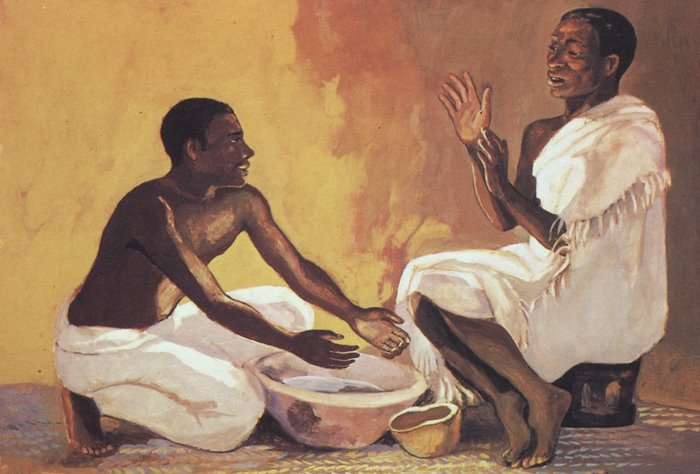
Peter said to him, “You will never wash my feet.”  Jesus answered, “Unless I wash you, you have no share with me.”

I’m always a little uneasy about Maundy Thursday services because I know what’s coming: foot washing.  Oh, the humility!  To let someone wash my feet!  So embarrassing. 

Peter says to Jesus, “You will never wash my feet.” 

Why is it so hard for us to let others serve us?

Pedro le dijo: “¡Jamás permitiré que me laves los pies!”

Respondió Jesús: “Si no te los lavo, no podrás ser de los míos.”

Siempre estoy un poco nerviosa en los servicios de Jueves Santo porque ya sé lo que viene: lavatorio de pies. ¡La humildad!  No quiero que alguien lave mis pies!  Que vergüenza.

Pedro le dijo: “¡Jamás permitiré que me laves los pies!”

¿Por qué es tan difícil dejar que otros nos sirvan?

When Jay and I were married, we carefully selected hymns that we felt would be important to our relationship moving forward.  The hymn we most loved started with the following words:

Brother, sister, let me serve you.

Let me be as Christ to you.

Pray that I may have the grace

to let you be my servant too.

I need prayers and grace to let you serve me.  Why?

Cuando Jay y yo nos casamos, nosotros seleccionamos con cuidado cada himno pensando en lo que sería importante para nuestro futuro juntos.  El himno que nos gustó más tiene este verso:

Hermano, hermana, déjame servirle

Déjame ser como Cristo es a usted.

Ora que yo pueda tener la gracia

De Dejarle a usted ser mi siervo también.

Yo necesito oraciones y gracia para que alguien pueda servirme—por qué?

To let you serve me requires a bit more humility and intimacy than we’re used to in today’s society. 

We are taught to be independent.  Self-sufficient.  Strong. 

To bear my feet.  To make myself vulnerable.  To let you wash away my dirt and smell.  There’s no room for pride in that! 

Para dejar a alguien que me sirva requiere un poco más humildad e intimidad que lo que estamos acostumbrados en la sociedad de hoy.

La sociedad dice que debemos ser independientes.  Autosuficientes.  Fuertes.

Para enseñar mis pies.  Para ser vulnerable.  Para dejarle a alguien lavar mi suciedad y olor.  ¡No hay lugar para orgullo en esto!

http://diglib.library.vanderbilt.edu/act-imagelink.pl?RC=48299

We are used to sitting on buses and subways pressed up against each other without ever making eye contact.  We have conversations over text messages, emails and facebook without ever having to listen to another’s voice.  We insulate ourselves from the world around us, making sure we look busy and put together at all times, always putting our best foot forward, always playing to our strengths. 

But to strip away those layers of technology, appearance, expectations and social pressures.  To let you see my weaknesses.  My naked feet.  That seems a little too close for comfort in this day and age. 

Jesus answered, “Unless I wash you, you have no share with me.” 

Estamos acostumbrados a sentarnos en los autobuses y trenes apretados unos contra otros sin contacto visual.  Tenemos conversaciones sobre mensajes de texto, email y Facebook sin escuchar la voz de un amigo.  Nos aislamos del mundo, asegurándonos que parecemos ocupados y bien preparados, siempre poniendo el mejor pie adelante, siempre demostrando nuestras fuerzas.

Pero para quitar cosas de tecnología, apariencia, expectaciones sociales.  Para dejarle ver mis debilidades.  Mis pies desnudos.  Eso me parece incomodo.

Respondió Jesús: “Si no te los lavo, no podrás ser de los míos.”

I looked up the Greek word for “share” used in John’s Gospel: μέρος (meros).  It means portion or part.  Jesus invites us to share in his ministry, to share in serving the world and in sharing God’s love.  But I can’t do my part unless I take off my “shoes” and let Jesus wash me.  I need God to love me so I can share God’s love.  I need Jesus to teach me so I can teach others.  I need people to pray for me so I can pray for the world. 

And all of this requires me to strip myself of my ego, my safety net, my distractions, my anger, and tonight my shoes—and to be served.  If I allow myself to be open to service, if I pray for the grace to let you serve me, then I’ll know what I’m asking of you when I say, “Brother, sister, let me serve you.”

Jesús nos invita a compartir en su ministerio, compartir sirviendo al mundo, compartir el amor de Dios.  Pero no puedo hacer mi parte si no me quito mis “zapatos” y dejar que Jesús lave mis pies.  Necesito que Dios me ame para que pueda compartir el amor de Dios.  Necesito que Jesús me enseñe para que yo también pueda enseñar.  Necesito que otros oren por mí para que yo pueda orar por el mundo.

Y todo esto demanda que quite mi ego, mi seguridad, mis distracciones, mi ira, y esta noche mis zapatos—para ser servida.  Si permito ser servida, si pido a Dios por la gracia de dejarle servirme, quizás sabré lo que pido cuando le digo, “hermano, hermana, déjenme servirle.”

I’m taking a class on addiction right now, and one of the requirements is to attend several 12-step meetings.  The people in the AA meeting I attended last week understand what it is to share.  Again and again I listened to people share their stories, and then to say, “it helps me to share this with you.”  And many people listening would follow up saying, “it helps me to hear your story.” The meeting was a constant give-and-take of serving and being served. 

I think the reason this works so well in AA is that every person who walks in that room has to check their pride at the door.  When you introduce yourself, you share your name, and then you name your weakness.  It’s not, “I’m Jack, and I’m an awesome father.”  Or “I’m Sally, and I’m a successful lawyer.”  But, “I’m Alex, and I’m an alcoholic, or a drug addict, or a gambler, or an over-eater, or a sex addict.”  It’s as if they say their name and take off their shoes in the same breath.

Una de mis clases es sobre la adicción, y uno de los requisitos es asistir a varias reuniones de 12-pasos.  La gente en la reunión de AA que asistí la semana pasada entiende lo que es compartir.  Varias personas comparten sus historias, y luego dicen, “me ayuda compartir esto con ustedes.”  Y algunas responden, “me ayuda a conocer su historia.”  La reunión era una constante toma y da de servir y ser servido.

Creo que la razón por la cual esto funciona bien en AA es que cada persona que entra a la reunión tiene que dejar su orgullo en la puerta.  Cuando se presenta, dice su nombre, y dice su debilidad.  No es, “Me llamo Jack, y soy un padre increíble,” o “Me llamo Sally, y soy abogado con éxito.”  No es esto.  Pero, “Me llamo Alex, y soy alcohólico.”  Es como si dicen su nombre y quitan sus zapatos al mismo tiempo.

Peter said to Jesus, “You will never wash my feet.”

Jesus answered, “Unless I wash you, you have no share with me.”

May we all take off our shoes tonight, whether they be shoes of pride or of fear or shame or loneliness.  May we take off our shoes and be washed by Christ’s love and be fed by Christ’s feast so that we too may share in Christ’s ministry.

Pedro le dijo: “¡Jamás permitiré que me laves los pies!”

Respondió Jesús: “Si no te los lavo, no podrás ser de los míos.”

Que zapatos nuestros quitamos esta noche, ya sean zapatos de orgullo, o de miedo, de vergüenza o soledad.  Que quitemos nuestros zapatos y seamos lavados por el amor de Cristo y seamos alimentados por la fiesta de Cristo para que también nosotros podamos compartir en el ministerio de Cristo.

Amen.

Tagged , , , , , , ,

I got to keep on movin’

Preached on the Second Sunday of Lent at St. Matthew & St. Timothy, New York

Genesis 15:1-12, 17-18; Philippians 3:17-4:1; Luke 13:31-35

“Jerusalem, Jerusalem, the city that kills the prophets and stones those who are sent to it!  How often have I desired to gather your children together as a hen gathers her brood under her wings, and you were not willing!”

Oh, how Jesus laments for God’s chosen people.  He cries out in both frustration and love.  Ah!  Jerusalem!  I love you!  I want to care for you!  But you make it so hard!

For several weeks now, Mother Carla has been asking us to consider where we picture ourselves years from now—what we will be doing, who we will be with, how we will be spending our time and our talents…and then to consider where Jesus desires us to be.  Is it the same place?  Do my desires for myself and God’s desires for me coincide?  Or is there tension between how I want to spend my time and how God might be calling me to spend my time. 

Is Jesus calling out my name in frustration and love?  Is he calling out yours?

I have a confession to make.  I am a very stubborn person.  And I’m also someone who worries about what others think of me.  I want to be liked, to earn the approval of others.  Several years ago, I was living in Benin, West Africa as a missionary.  I had intended to live there two years, but it soon became clear that I just couldn’t cut it.  I had to go home. 

And with that realization came the fear of how others would perceive my decision.  Would they think I was weak?  A quitter?  A wimp?  Would they think my faith wasn’t strong enough?  At some point, I knew in my heart that going home was the right thing to do, that God would care for me despite the many unknowns, and who cares what people think?

After figuring out this whole—you’re going to be ok, God will care for you, don’t worry about what others think—revelation, I got a little perturbed with God.  I said to God, “Really?  Did you have to bring me all the way to Africa to figure this out?”  And in my heart, I could hear God’s response plain as day: “Yes, Lauren, you’re just that stubborn.”

It’s true.  I’m stubborn.  And sometimes God has to go to great lengths to teach me something. 

Like Jerusalem, we are God’s people.  During baptism we are “marked and sealed as Christ’s own forever.”  We use Christ’s name to identify ourselves as Christians.  And Like Jerusalem, we too can cause God to call out in lament and frustration. 

Are you familiar with the term “face-palm?”  It’s when one smacks their palm to their forehead—like so:

Here are some Jesus face-palm moments I can imagine:

When Westboro Baptist Church holds up signs reading, “God hates Gays” at the funeral of a fallen soldier.  Face-palm.

When a priest apologizes for participating in an interfaith memorial service for the children of Newtown.  Face-palm.

When a church tries to cover up clergy pedophilia.  Face-palm. 

When I am too self-absorbed to make eye contact with the homeless man sitting outside the seminary gate. 

When I gossip about a peer because it makes me feel more secure. 

When I ignore a call from a friend or family member because I’ve got more important things to do. 

Face-palm, face-palm, face-palm.

Jerusalem, Jerusalem!  Christians, Christians!  You!  Me!  Us!

And even in his exasperation, Jesus longs to care for us.  “How often have I desired to gather your children together as a hen gathers her brood under her wings.”  It’s as if he’s shouting, “HEY!  Let me love you!”

Gosh, we can be stubborn.  The good news is: Jesus is stubborn too.

Jesus is traveling in much of Luke’s Gospel.  From chapter 9 to chapter 19, Jesus is making his way from the region of Galilee to the city of Jerusalem.  I imagine it takes him as long as it does because he is so busy healing people.  When the Pharisees tell Jesus he needs to get a move on because Herod is coming to kill him, Jesus says, “Tell that fox I’m busy healing people and casting out demons!”  And then he reminds us that he’s on a journey to Jerusalem.  Jesus knows what to expect in Jerusalem.  He knows he’s journeying toward death.  But dying is just as much a part of Jesus’ ministry as healing people and casting out demons.  Indeed dying is integral to Jesus’ ministry—he’s got to die if he’s going to conquer death.  And so he keeps journeying, keeps healing, keeps fighting evil despite Herod’s threats and Jesus’ impending death.  This is a stubborn Jesus.

Here’s why I’m talking about stubbornness and journeying.  Because we too are on a journey to Jerusalem.  And we too know what to expect—a dying savior.  During this season of Lent we think about the sacrifice Christ made in love for us—He stretched out his arms of love on the hard wood of the cross.  “Jerusalem, Jerusalem!  How often have I desired to gather your children together as a hen gathers her brood under her wings.” 

We are preparing ourselves to accept God’s love for us.  We are preparing ourselves for the life that Love calls us to lead.  We are on a journey.

And this preparation, it takes time.  Habits are hard to break and make.  30 days remain in Lent.  Is God calling out to you?  Do you hear frustration?  Do you hear love?  Perhaps both? 

What will it take for us to let God’s love rule our lives.  What will it take for us to live risky, messy, Christ-like lives.  What will it take for me to align my plans with God’s plans as Mother Carla has challenged us to imagine.  You may be stubborn like me.  But Jesus is stubborn too.  And we’ve still got 30 days. 

Lets make them count.  Amen. 

Tagged , , , , , ,

Me gusta mueve, mueve.

24 Febrero, 2013—Cuaresma 2C—Iglesia de San Mateo & San Timoteo, Nueva York

Génesis 15:1-12, 17-18; Filipenses 3:17-4:1; San Lucas 13:31-35

 “¡Jerusalén, Jerusalén, que matas a los profetas y apedreas a los mensajeros que Dios te envía! ¡Cuántas veces quise juntar a tus hijos, como la gallina junta sus pollitos bajo las alas, pero no quisiste!

Como Jesús se lamenta por la gente elegida de Dios.  Él clama en frustración y amor.  ¡Ah, Jerusalén!  ¡Te amo! ¡Quiero cuidarte!  Pero tú lo haces tan difícil.

Hace unas semanas, Madre Carla nos preguntó que a dónde nos imaginamos a nosotros mismos en unos años—lo que haremos, con quién estaremos, cómo pasaremos nuestro tiempo y usaremos nuestros talentos… también nos preguntó que dónde nos imaginamos que Jesús quiere que estemos.  ¿Es el mismo lugar?  ¿Mis deseos de mí y los deseos de Dios de mí coinciden?  Quizás hay tensión entre cómo quiero pasar mi tiempo y cómo Dios quiere que pase mi tiempo.

¿Llama Jesús mi nombre en frustración y amor?  ¿Llama el suyo?

Tengo una confesión que hacer.  Soy una persona muy obstinada. Y también soy una persona que se preocupa de lo que otros piensan de mí.  Quiero ser querida, quiero ganar la aprobación de otros.  Hace unos años, vivía en Benin, África como misionera.  Tenía la intención de vivir allí dos años, pero pronto quedó claro que yo simplemente no podía quedarme.  Tuve que volver a los Estados Unidos. 

Y con esa realización vino el miedo de cómo otros percibirían mi decisión.  ¿Piensan que yo era débil?  ¿Una desertora?  ¿Una cobarde?  ¿Piensan que mi fe no era bastante fuerte?  A algún punto, sabía en mi corazón que irse a casa era la cosa correcta para hacer, que Dios cuidaría de mí en cada momento, ¿y qué importa lo que la gente piensa?

Después de esta revelación, estaba un poco enojada con Dios, “¿En serio?  ¿Me tuvo que traer a África para que yo pudiera entender esto?”  Y en mi corazón, podía oír la respuesta de Dios: “Sí, Lauren, eres tan obstinada.” 

Es cierto.  Soy obstinada.  Y a veces Dios tiene que usar mucha fuerza para enseñarme algo.

Como Jerusalén, somos el pueblo de Dios. Durante el bautismo somos “marcados y sellados como de Cristo para siempre”. Utilizamos el nombre de Cristo para identificarnos como cristianos. Y como Jerusalén, nosotros también podemos causar a Dios  gritar en lamento y frustración.

¿Está usted familiarizado con la frase “facepalm” en ingles, o “mano en la cara”?  Es cuando uno golpea su cara con la mano, significando vergüenza ajena—así:


Yo imagino que Jesús lo hace en los siguientes momentos:

Cuando Westboro Baptist Church levanta signos que dice, “Dios odia los Gays” en el funeral de un soldado.

Cuando un sacerdote se disculpa por participar en un servicio interreligioso memorial para los niños de Newtown. 

Cuando la iglesia trata de cubrir la pedofilia del clero u otros líderes.

Cuando estoy demasiado ensimismado para ver el hombre sin hogar sentado fuera de la puerta del seminario. 

Cuando chismeo sobre un compañero/a para sentirme más segura. 

Cuando ignoro una llamada de un amigo o un miembro de mi familia porque tengo cosas más importantes que hacer. 

¡Jerusalén, Jerusalén! ¡Cristianos, cristianos! ¡Yo! ¡Usted! ¡Nosotros!

Aún con su exasperación, Jesús quiere cuidar de nosotros.  “¡Cuántas veces quise juntar a tus hijos, como la gallina junta sus pollitos bajo las alas!”  Es como si él grita, “¡Oye!  ¡Déjeme amarle!”

Ay, como podemos ser obstinados.  Las buenas noticias son: Jesús es obstinado también. 

Jesús está viaja mucho en el Evangelio de San Lucas.  Desde el capítulo 9 al capítulo 19, Jesús hace su camino de la región de Galilea a la ciudad de Jerusalén.  Me imagino que su viaje toma mucho tiempo porque él está tan ocupado curando la gente.  Cuando los fariseos dicen a Jesús  que debe irse porque Herodes viene para matarle, Jesús dice, “¡Díganle a ese zorro que estoy ocupado curando la gente y expulsando a demonios!”  Y nos recuerda que él esta en un viaje a Jerusalén.  Jesús sabe lo que va a suceder en Jerusalén.  Él sabe que está caminando hacia la muerte.  Pero morir es una parte del ministerio de Jesús, como curando los enfermos y expulsando demonios.  En efecto, morir es esencial para el ministerio de Jesús—hay que morir para conquistar la muerte. 

Y así sigue viajando, sigue curando, sigue luchando contra el mal a pesar de amenazas de Herodes y muerte inminente.  Esto es el Jesús obstinado.

Por eso estoy hablando de obstinación y viaje.  Porque también nosotros estamos en un viaje a Jerusalén.  Y también nosotros sabemos lo que nos espera—la muerte de nuestro salvador. 

Durante este tiempo de Cuaresma, pensamos en el sacrificio que Cristo ha hecho en amor por nosotros—él extendió sus brazos amorosos sobre el cruel madero de la cruz.  “¡Jerusalén, Jerusalén, que matas a los profetas y apedreas a los mensajeros que Dios te envía! ¡Cuántas veces quise juntar a tus hijos, como la gallina junta sus pollitos bajo las alas!” 

Nos preparamos para aceptar el amor de Dios por nosotros.  Nos preparamos para la vida que el Amor nos llama a vivir.  Estamos en un viaje. 

Y esta preparación toma tiempo.  Hábitos son difíciles de romper y de hacer.  30 días permanecen en la Cuaresma.  ¿lo llama Dios a usted?  ¿Oye frustración?  ¿Oye amor?  ¿Quizás ambos? 

¿Qué necesitamos para que el poder de Dios gobierne nuestras vidas?  ¿Qué necesitamos para vivir vidas arriesgadas, desordenadas, parecidas a Cristo?  ¿Qué necesito para alinear mis planes con los planes de Dios como Madre Carla nos ha pedido imaginar?  Quizás usted puede ser obstinado como yo.  Pero Jesús es obstinado también.  Y todavía nos quedan 30 días. 

Que la Cuaresma nos mueva y nos cambie.  Amén.

Tagged , , , ,

Tips for Turkey

Today’s tours were cut short by lots and lots of rain and thunderstorms. We did make it to Assos where Paul was at least twice, meeting Luke once. Aristotle was also there. And you can see the island of Lesbos across the way, from which we get the word “lesbian”… No really!

We missed Alexandria Troas because of the rain.

We made it to Troy, where I visited the model horse of ancient lore, the museum, and the restrooms. I’ll have a better visit sans rain someday with my someday children after we’ve read the Iliad together. Haha.

Since today’s sites were brief, I thought I’d offer vocab lesson.
hello: merhaba
good morning: günaydin
good night: iyi geceler
good bye: güle güle
thank you: tesekkür (the s sounds like sh)
yes: evet
no: hayir (pronounced hire)

There’s no use in learning “how much?” or “how many?” unless you know all your numbers too.

$1 is about 1.76 Turkish Lira

Tip is generally 10%

If you are a lady in line for the restrooms and don’t mind using a hole in the ground, you can cut in line. Sometimes you have to pay 1TL to use the restroom.

There are cats and dogs everywhere and they are very friendly, well mannered, and well cared for. Those of us with pets back home have been grateful for the love these animals offer us at the sites.

I’ll add to this list later if I think of more tips…

Tagged , , ,

Silly Romans

Our guide, Gülin, told us that someone once asked on one of her tours, “Why did the Romans build so many ruins?” (Chuckle…)

After five days of visiting ~15 ruins, we find ourselves facetiously asking the same question. But the cool thing about seeing one Hellenistic/Roman/Byzantine site after another is that you really start to picture where the church was born—not just the Christian parts, but the whole of society that early Christians took part in. It’s like going from translating English to Spanish one word at a time, to thinking in Spanish. I can feel my mind starting to “think in” Early Christianity.

In the past two days we have been to:
Pamukkale the “cotton cliffs” of mineral deposits and thermal pools.
Hierapolis 2km of tombs in a necropolis on the hillside… As strange as it sounds, playing around in this graveyard was one of my favorite stops yet!
Sardis the first place to mint coins, biggest synagogue up until the Jews were driven out in 600CE, most grand “YMCA” we’ve seen (and we’ve seen a lot!)
Temple of Artemis not to be confused with the Artemisian temple from Saturday.
Acropolis at Pergamon the most magnificent view of the Turkish countryside from the highest ruins—just amazing. It was especially cool to hear simultaneous calls to prayer from 5-10 minarets in the village below echoing off the mountains.
Asklepion with healing waters and a temple to the God of Health (of course I had a sip…)
The Red Hall a church with Egyptian influence.

And something purely cultural we did today… A visit to a rug making co-op in Bergama. We watched how they make wool yarn, how they make silk threads, how they make various colors of dye, how they weave different types of rugs—it was amazing. I wish my dad could have been there with me. I bought a rug that I think Jay and I will hang on the wall of our next home. What a day.

And now I’m sitting in our hotel along the Aegean Sea, ready for bed.

Tagged , , , , , ,

Historical imagination & imaginary history

Here are some useful things to keep in mind while visiting ruins anywhere…

There are three approaches to excavating:
1. When you find something, leave it as it is.
2. When you find something, try to reconstruct it using your research and imagination.
3. When you find something, dig it all up to see if there are older or more valuable ruins beneath it.

We have seen evidence of all three approaches in the past few days. In Ephesus we saw some Byzantine ruins, but most of them had been ripped up to get to Roman ruins beneath. My professor who used to work on that site said that she recalls reading the journals in German and seeing the phrase, “then we brought in the bulldozers…” Ugh! So much history gained, but so much lost.

And then there’s the bit about using your imagination. We all do this every time we come to a site with only bits and pieces of buildings. But we can get carried away with our imaginations too. Today we went to a site in Laodicea where archeologists are making what seem to be wild claims. If they are correct, we just saw the earliest church known to humanity. And that would be awesome. I’m glad I saw it. The oldest church we’ve uncovered thus far dates late 400’s, this one claims to be 312. Discoveries like this take time, and the archeologists at Laodicea seem to be in a rush to finish. My hope is that they don’t get sloppy in their rush. In any case, it was especially cool to see a site being actively excavated and to get any idea of the work that goes into it.

Imagination comes into play in our spirituality as well. Yesterday’s trip to the House of the Virgin Mary, for instance—did Mary really spend her final days there? Catholics say yes, Orthodox say no. But whether she did or not, the place is religiously significant and spirit-filled based based on the millions who have made pilgrimages there, prayed there, been changed there.

So come to Turkey with a healthy dose of academic skepticism, but don’t let it close you off to the real wonders that have been and still are.

PS Aphrodesia was an amazing site as well—both because the ruins give you an especially vivid idea of what a typical Roman city looked like, and because the vistas are breathtaking.

Tagged , , , , ,

Emphasis on Ephesus

Today was a very full day in Ephesus. But one thing Ephesus was not full of: people. Turns out there are some perks to visiting Turkey in the winter!

We started at the Church of Mary–where it is thought the Third Ecumenical Council in 431 CE took place. The third council is where Bishops agreed on the title Theotokos or “God bearer” for Mary. There happens to be a great baptistry there as well that a few of us took turns getting into.

Next we walked up the “Harbor Road” from the harbor uphill into the town. It’s truly amazing to behold. You can see where stalls and shops would have been and just imagine the hustle and bustle of antiquity. A great theater seating 25,000 sits atop the hill. It may be the largest outdoor theater in the world. The scope is just breathtaking.

Hang a right and you’re on your way to the Roman Library of Celsus, originally constructed in 125 CE. This library would have housed 12,000 scrolls. The architecture is magnificent.

From the library the road goes up another hill, lined once again with shops and such. On the left side of the road is an extremely well preserved latrine. One of the few places our professor said she could be sure Paul visited, ha. Jay asked why such a thing would be preserved, and I can tell you that you’d understand why if you saw it. There must have been 40+ latrines lining the periphery of this single room at one time. Can you imagine all those men pooping together? And that was only the men that could afford it! How strange.

Across the street from the latrines is the entrance to some magnificent ruins of terraced houses. These houses are still being excavated, so they are covered from the elements (shielding us from the rain too!) It is so cool to see a live worksite. One of our professors worked on this very site back in 2009, so she was a wealth of information. I took particular interest in the eating areas since that is what I’m studying while I am here, but I’ll write more on that later when I have pictures handy.

Walking further up the road, we passed a number of bath houses. What is it about the Greco-Romans and their gyms and baths? It’s like a YMCA on every corner!

We saw another smaller theater for official announcements and the victorious goddess of Nike. We saw statues with crosses on the accompanying inscriptions indicating their Christian faith. We saw sheep on the hillsides and caves. It was like a 3-D backdrop to the Bible. So cool.

We stopped for a late lunch of home cooked food–the cook was expecting us. I bought her cookbook it was so good. Lamb meatballs, okra, spinach, chicken, beans, eggplant, stuffed peppers, yogurt, fried cauliflower, more eggplant, and some dessert made out of crushed walnuts and cinnamon. And apple tea.

Next we swung by the Temple of Artemis, one of the Seven Wonders of the World. Only one column remains of it now.

And finally we made our way to the House of the Virgin Mary–believed by Roman Catholics and others to be where Mary lived out her final days after John brought her to Ephesus. The Eastern Orthodox do not believe this to be where Mary lived, but people of many faith traditions make pilgrimage there regardless. I can say I was moved. I lit two candles and I bought two blue Mary medallions which I dipped in the Holy spring waters outside the house. (Spoiler alert, Mom… I knew you’d want one!)

A great day that will stick with me forever. Now if I can only get some sleep!

Tagged , , , , , , , ,

Turkey: first impressions

After 24 hours of airplanes, airports, and buses, we arrived to Yeni Hitit Hotel in Selçuk Thursday evening. Everything is lovely and cold.

The lovely: Our guide Gülin (pronounced Goo-leen). Our warm Mercedes bus. Our slightly gentrified (I mean that in the best way–think of all the life experiences I can learn from!) group of 33 interesting people. Our two professors from back home. The people here. The food. The countryside. The sunset last night. The naps. The sites.

The cold: Sleeping in socks, pants, long sleeve shirt. Two wool blankets. Heat on full force (but windows and walls as breezy as the seminary). Turning the hair dryer on while using the bathroom. Standing in the cold rain, walking in the cold rain, grateful for respites on the warm bus.

Supper last night consisted of a soup with some kick to it, beets, couscous, yogurt with some dark red paste, broccoli, lettuce & tomato, potatoes, small tasty meatballs, cooked spinach, rice, chicken, and chocolate pudding. Then I asked for the sage tea, which was a simple sprig of sage with some lemon slices and hot water. Beautiful!

Breakfast this morning included homemade goat cheese, yogurt with fig compote, hard and soft boiled eggs, rolls, hot chocolate and tea. There were other items, but that was my selection!

Both breakfast and supper are served buffet style at our hotel.

We loaded up our bus at 8:30am and made our way to Miletus. It is crazy to think that the roads we are driving on used to be covered by the sea. The ruins we saw at Miletus were once on a peninsula surrounded by water. We walked around a Greco-Roman theater (4C BC), read Greek inscriptions, saw Hellenistic, Roman, Byzantine and Ottoman structures from a single vantage point. We used our imaginations a lot.

Next we headed to Didyma (or Priene) for a visit and lunch. The ruins of the Temple to Apollos are unique architecturally, but typical in other ways. You could tell that the temple was unfinished (even though it was used) because of certain non-fluted columns, inscriptions in some of the stones indicating which quarry they had been brought from (these would have been smoothed out), and knobs on some of the stones that would have been used to pull them from the quarry. It was not unusual to leave a temple unfinished, as funds would sometimes run out–not unlike today! We did not get any word from the oracle.

We had lunch in a cafe facing the ruins: roasted zucchini squash and tomato, salad, and whole fish. My fish was twice the size of my plate!

I slept on the bus as we made our way back to Ephesus (Selçuk, where we are staying, is right next to Ephesus). We’ll spend more time in Ephesus tomorrow, but today we just stopped by the Basilica of St. Jean (St. John) 4C BC. Legend has it that John, the Beloved disciple, brought the Blessed Virgin to Ephesus after the resurrection of Jesus. John’s remains are believed to be at the basilica–so supposedly I saw those today. Many people have made pilgrimages here for that reason! My favorite part was the baptistry–which I’ll have to sketch out at some point. Father Malloy would have approved.

Tomorrow we are in Ephesus all day. I’m hoping it will be warmer and dryer, but it’s not looking likely.

Other random things of note: solar water heaters on every roof, orange trees, olive trees, wind turbines, paying for restrooms, minarets and calls to prayer, lots of happy dogs and a guy with a trunk-full of sardines.

That’s a wrap for our first day of touring about.

Tagged , , ,