Category Archives: letter press

Pies desnudos: a Bilingual Maundy Thursday Sermon

Preached at The Church of St. Matthew and St. Timothy in New York City on Maundy Thursday, 2013. 

LectionaryExodus 12:1-4, 11-14; 1 Corinthians 11:23-26; John 13:1-17, 31b-35.

Peter said to him, “You will never wash my feet.”  Jesus answered, “Unless I wash you, you have no share with me.”

I’m always a little uneasy about Maundy Thursday services because I know what’s coming: foot washing.  Oh, the humility!  To let someone wash my feet!  So embarrassing. 

Peter says to Jesus, “You will never wash my feet.” 

Why is it so hard for us to let others serve us?

Pedro le dijo: “¡Jamás permitiré que me laves los pies!”

Respondió Jesús: “Si no te los lavo, no podrás ser de los míos.”

Siempre estoy un poco nerviosa en los servicios de Jueves Santo porque ya sé lo que viene: lavatorio de pies. ¡La humildad!  No quiero que alguien lave mis pies!  Que vergüenza.

Pedro le dijo: “¡Jamás permitiré que me laves los pies!”

¿Por qué es tan difícil dejar que otros nos sirvan?

When Jay and I were married, we carefully selected hymns that we felt would be important to our relationship moving forward.  The hymn we most loved started with the following words:

Brother, sister, let me serve you.

Let me be as Christ to you.

Pray that I may have the grace

to let you be my servant too.

I need prayers and grace to let you serve me.  Why?

Cuando Jay y yo nos casamos, nosotros seleccionamos con cuidado cada himno pensando en lo que sería importante para nuestro futuro juntos.  El himno que nos gustó más tiene este verso:

Hermano, hermana, déjame servirle

Déjame ser como Cristo es a usted.

Ora que yo pueda tener la gracia

De Dejarle a usted ser mi siervo también.

Yo necesito oraciones y gracia para que alguien pueda servirme—por qué?

To let you serve me requires a bit more humility and intimacy than we’re used to in today’s society. 

We are taught to be independent.  Self-sufficient.  Strong. 

To bear my feet.  To make myself vulnerable.  To let you wash away my dirt and smell.  There’s no room for pride in that! 

Para dejar a alguien que me sirva requiere un poco más humildad e intimidad que lo que estamos acostumbrados en la sociedad de hoy.

La sociedad dice que debemos ser independientes.  Autosuficientes.  Fuertes.

Para enseñar mis pies.  Para ser vulnerable.  Para dejarle a alguien lavar mi suciedad y olor.  ¡No hay lugar para orgullo en esto!
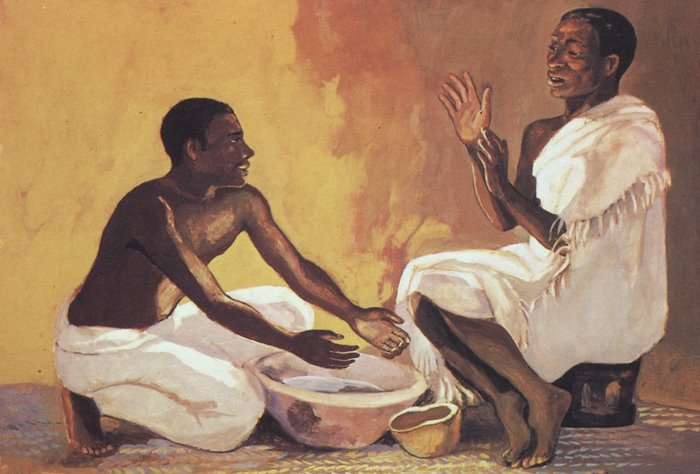
http://diglib.library.vanderbilt.edu/act-imagelink.pl?RC=48299

We are used to sitting on buses and subways pressed up against each other without ever making eye contact.  We have conversations over text messages, emails and facebook without ever having to listen to another’s voice.  We insulate ourselves from the world around us, making sure we look busy and put together at all times, always putting our best foot forward, always playing to our strengths. 

But to strip away those layers of technology, appearance, expectations and social pressures.  To let you see my weaknesses.  My naked feet.  That seems a little too close for comfort in this day and age. 

Jesus answered, “Unless I wash you, you have no share with me.” 

Estamos acostumbrados a sentarnos en los autobuses y trenes apretados unos contra otros sin contacto visual.  Tenemos conversaciones sobre mensajes de texto, email y Facebook sin escuchar la voz de un amigo.  Nos aislamos del mundo, asegurándonos que parecemos ocupados y bien preparados, siempre poniendo el mejor pie adelante, siempre demostrando nuestras fuerzas.

Pero para quitar cosas de tecnología, apariencia, expectaciones sociales.  Para dejarle ver mis debilidades.  Mis pies desnudos.  Eso me parece incomodo.

Respondió Jesús: “Si no te los lavo, no podrás ser de los míos.”

I looked up the Greek word for “share” used in John’s Gospel: μέρος (meros).  It means portion or part.  Jesus invites us to share in his ministry, to share in serving the world and in sharing God’s love.  But I can’t do my part unless I take off my “shoes” and let Jesus wash me.  I need God to love me so I can share God’s love.  I need Jesus to teach me so I can teach others.  I need people to pray for me so I can pray for the world. 

And all of this requires me to strip myself of my ego, my safety net, my distractions, my anger, and tonight my shoes—and to be served.  If I allow myself to be open to service, if I pray for the grace to let you serve me, then I’ll know what I’m asking of you when I say, “Brother, sister, let me serve you.”

Jesús nos invita a compartir en su ministerio, compartir sirviendo al mundo, compartir el amor de Dios.  Pero no puedo hacer mi parte si no me quito mis “zapatos” y dejar que Jesús lave mis pies.  Necesito que Dios me ame para que pueda compartir el amor de Dios.  Necesito que Jesús me enseñe para que yo también pueda enseñar.  Necesito que otros oren por mí para que yo pueda orar por el mundo.

Y todo esto demanda que quite mi ego, mi seguridad, mis distracciones, mi ira, y esta noche mis zapatos—para ser servida.  Si permito ser servida, si pido a Dios por la gracia de dejarle servirme, quizás sabré lo que pido cuando le digo, “hermano, hermana, déjenme servirle.”

I’m taking a class on addiction right now, and one of the requirements is to attend several 12-step meetings.  The people in the AA meeting I attended last week understand what it is to share.  Again and again I listened to people share their stories, and then to say, “it helps me to share this with you.”  And many people listening would follow up saying, “it helps me to hear your story.” The meeting was a constant give-and-take of serving and being served. 

I think the reason this works so well in AA is that every person who walks in that room has to check their pride at the door.  When you introduce yourself, you share your name, and then you name your weakness.  It’s not, “I’m Jack, and I’m an awesome father.”  Or “I’m Sally, and I’m a successful lawyer.”  But, “I’m Alex, and I’m an alcoholic, or a drug addict, or a gambler, or an over-eater, or a sex addict.”  It’s as if they say their name and take off their shoes in the same breath.

Una de mis clases es sobre la adicción, y uno de los requisitos es asistir a varias reuniones de 12-pasos.  La gente en la reunión de AA que asistí la semana pasada entiende lo que es compartir.  Varias personas comparten sus historias, y luego dicen, “me ayuda compartir esto con ustedes.”  Y algunas responden, “me ayuda a conocer su historia.”  La reunión era una constante toma y da de servir y ser servido.

Creo que la razón por la cual esto funciona bien en AA es que cada persona que entra a la reunión tiene que dejar su orgullo en la puerta.  Cuando se presenta, dice su nombre, y dice su debilidad.  No es, “Me llamo Jack, y soy un padre increíble,” o “Me llamo Sally, y soy abogado con éxito.”  No es esto.  Pero, “Me llamo Alex, y soy alcohólico.”  Es como si dicen su nombre y quitan sus zapatos al mismo tiempo.

Peter said to Jesus, “You will never wash my feet.”

Jesus answered, “Unless I wash you, you have no share with me.”

May we all take off our shoes tonight, whether they be shoes of pride or of fear or shame or loneliness.  May we take off our shoes and be washed by Christ’s love and be fed by Christ’s feast so that we too may share in Christ’s ministry.

Pedro le dijo: “¡Jamás permitiré que me laves los pies!”

Respondió Jesús: “Si no te los lavo, no podrás ser de los míos.”

Que zapatos nuestros quitamos esta noche, ya sean zapatos de orgullo, o de miedo, de vergüenza o soledad.  Que quitemos nuestros zapatos y seamos lavados por el amor de Cristo y seamos alimentados por la fiesta de Cristo para que también nosotros podamos compartir en el ministerio de Cristo.

Amen.

Tagged , , , , , , ,

I got to keep on movin’

Preached on the Second Sunday of Lent at St. Matthew & St. Timothy, New York

Genesis 15:1-12, 17-18; Philippians 3:17-4:1; Luke 13:31-35

“Jerusalem, Jerusalem, the city that kills the prophets and stones those who are sent to it!  How often have I desired to gather your children together as a hen gathers her brood under her wings, and you were not willing!”

Oh, how Jesus laments for God’s chosen people.  He cries out in both frustration and love.  Ah!  Jerusalem!  I love you!  I want to care for you!  But you make it so hard!

For several weeks now, Mother Carla has been asking us to consider where we picture ourselves years from now—what we will be doing, who we will be with, how we will be spending our time and our talents…and then to consider where Jesus desires us to be.  Is it the same place?  Do my desires for myself and God’s desires for me coincide?  Or is there tension between how I want to spend my time and how God might be calling me to spend my time. 

Is Jesus calling out my name in frustration and love?  Is he calling out yours?

I have a confession to make.  I am a very stubborn person.  And I’m also someone who worries about what others think of me.  I want to be liked, to earn the approval of others.  Several years ago, I was living in Benin, West Africa as a missionary.  I had intended to live there two years, but it soon became clear that I just couldn’t cut it.  I had to go home. 

And with that realization came the fear of how others would perceive my decision.  Would they think I was weak?  A quitter?  A wimp?  Would they think my faith wasn’t strong enough?  At some point, I knew in my heart that going home was the right thing to do, that God would care for me despite the many unknowns, and who cares what people think?

After figuring out this whole—you’re going to be ok, God will care for you, don’t worry about what others think—revelation, I got a little perturbed with God.  I said to God, “Really?  Did you have to bring me all the way to Africa to figure this out?”  And in my heart, I could hear God’s response plain as day: “Yes, Lauren, you’re just that stubborn.”

It’s true.  I’m stubborn.  And sometimes God has to go to great lengths to teach me something. 

Like Jerusalem, we are God’s people.  During baptism we are “marked and sealed as Christ’s own forever.”  We use Christ’s name to identify ourselves as Christians.  And Like Jerusalem, we too can cause God to call out in lament and frustration. 

Are you familiar with the term “face-palm?”  It’s when one smacks their palm to their forehead—like so:

Here are some Jesus face-palm moments I can imagine:

When Westboro Baptist Church holds up signs reading, “God hates Gays” at the funeral of a fallen soldier.  Face-palm.

When a priest apologizes for participating in an interfaith memorial service for the children of Newtown.  Face-palm.

When a church tries to cover up clergy pedophilia.  Face-palm. 

When I am too self-absorbed to make eye contact with the homeless man sitting outside the seminary gate. 

When I gossip about a peer because it makes me feel more secure. 

When I ignore a call from a friend or family member because I’ve got more important things to do. 

Face-palm, face-palm, face-palm.

Jerusalem, Jerusalem!  Christians, Christians!  You!  Me!  Us!

And even in his exasperation, Jesus longs to care for us.  “How often have I desired to gather your children together as a hen gathers her brood under her wings.”  It’s as if he’s shouting, “HEY!  Let me love you!”

Gosh, we can be stubborn.  The good news is: Jesus is stubborn too.

Jesus is traveling in much of Luke’s Gospel.  From chapter 9 to chapter 19, Jesus is making his way from the region of Galilee to the city of Jerusalem.  I imagine it takes him as long as it does because he is so busy healing people.  When the Pharisees tell Jesus he needs to get a move on because Herod is coming to kill him, Jesus says, “Tell that fox I’m busy healing people and casting out demons!”  And then he reminds us that he’s on a journey to Jerusalem.  Jesus knows what to expect in Jerusalem.  He knows he’s journeying toward death.  But dying is just as much a part of Jesus’ ministry as healing people and casting out demons.  Indeed dying is integral to Jesus’ ministry—he’s got to die if he’s going to conquer death.  And so he keeps journeying, keeps healing, keeps fighting evil despite Herod’s threats and Jesus’ impending death.  This is a stubborn Jesus.

Here’s why I’m talking about stubbornness and journeying.  Because we too are on a journey to Jerusalem.  And we too know what to expect—a dying savior.  During this season of Lent we think about the sacrifice Christ made in love for us—He stretched out his arms of love on the hard wood of the cross.  “Jerusalem, Jerusalem!  How often have I desired to gather your children together as a hen gathers her brood under her wings.” 

We are preparing ourselves to accept God’s love for us.  We are preparing ourselves for the life that Love calls us to lead.  We are on a journey.

And this preparation, it takes time.  Habits are hard to break and make.  30 days remain in Lent.  Is God calling out to you?  Do you hear frustration?  Do you hear love?  Perhaps both? 

What will it take for us to let God’s love rule our lives.  What will it take for us to live risky, messy, Christ-like lives.  What will it take for me to align my plans with God’s plans as Mother Carla has challenged us to imagine.  You may be stubborn like me.  But Jesus is stubborn too.  And we’ve still got 30 days. 

Lets make them count.  Amen. 

Tagged , , , , , ,

Me gusta mueve, mueve.

24 Febrero, 2013—Cuaresma 2C—Iglesia de San Mateo & San Timoteo, Nueva York

Génesis 15:1-12, 17-18; Filipenses 3:17-4:1; San Lucas 13:31-35

 “¡Jerusalén, Jerusalén, que matas a los profetas y apedreas a los mensajeros que Dios te envía! ¡Cuántas veces quise juntar a tus hijos, como la gallina junta sus pollitos bajo las alas, pero no quisiste!

Como Jesús se lamenta por la gente elegida de Dios.  Él clama en frustración y amor.  ¡Ah, Jerusalén!  ¡Te amo! ¡Quiero cuidarte!  Pero tú lo haces tan difícil.

Hace unas semanas, Madre Carla nos preguntó que a dónde nos imaginamos a nosotros mismos en unos años—lo que haremos, con quién estaremos, cómo pasaremos nuestro tiempo y usaremos nuestros talentos… también nos preguntó que dónde nos imaginamos que Jesús quiere que estemos.  ¿Es el mismo lugar?  ¿Mis deseos de mí y los deseos de Dios de mí coinciden?  Quizás hay tensión entre cómo quiero pasar mi tiempo y cómo Dios quiere que pase mi tiempo.

¿Llama Jesús mi nombre en frustración y amor?  ¿Llama el suyo?

Tengo una confesión que hacer.  Soy una persona muy obstinada. Y también soy una persona que se preocupa de lo que otros piensan de mí.  Quiero ser querida, quiero ganar la aprobación de otros.  Hace unos años, vivía en Benin, África como misionera.  Tenía la intención de vivir allí dos años, pero pronto quedó claro que yo simplemente no podía quedarme.  Tuve que volver a los Estados Unidos. 

Y con esa realización vino el miedo de cómo otros percibirían mi decisión.  ¿Piensan que yo era débil?  ¿Una desertora?  ¿Una cobarde?  ¿Piensan que mi fe no era bastante fuerte?  A algún punto, sabía en mi corazón que irse a casa era la cosa correcta para hacer, que Dios cuidaría de mí en cada momento, ¿y qué importa lo que la gente piensa?

Después de esta revelación, estaba un poco enojada con Dios, “¿En serio?  ¿Me tuvo que traer a África para que yo pudiera entender esto?”  Y en mi corazón, podía oír la respuesta de Dios: “Sí, Lauren, eres tan obstinada.” 

Es cierto.  Soy obstinada.  Y a veces Dios tiene que usar mucha fuerza para enseñarme algo.

Como Jerusalén, somos el pueblo de Dios. Durante el bautismo somos “marcados y sellados como de Cristo para siempre”. Utilizamos el nombre de Cristo para identificarnos como cristianos. Y como Jerusalén, nosotros también podemos causar a Dios  gritar en lamento y frustración.

¿Está usted familiarizado con la frase “facepalm” en ingles, o “mano en la cara”?  Es cuando uno golpea su cara con la mano, significando vergüenza ajena—así:


Yo imagino que Jesús lo hace en los siguientes momentos:

Cuando Westboro Baptist Church levanta signos que dice, “Dios odia los Gays” en el funeral de un soldado.

Cuando un sacerdote se disculpa por participar en un servicio interreligioso memorial para los niños de Newtown. 

Cuando la iglesia trata de cubrir la pedofilia del clero u otros líderes.

Cuando estoy demasiado ensimismado para ver el hombre sin hogar sentado fuera de la puerta del seminario. 

Cuando chismeo sobre un compañero/a para sentirme más segura. 

Cuando ignoro una llamada de un amigo o un miembro de mi familia porque tengo cosas más importantes que hacer. 

¡Jerusalén, Jerusalén! ¡Cristianos, cristianos! ¡Yo! ¡Usted! ¡Nosotros!

Aún con su exasperación, Jesús quiere cuidar de nosotros.  “¡Cuántas veces quise juntar a tus hijos, como la gallina junta sus pollitos bajo las alas!”  Es como si él grita, “¡Oye!  ¡Déjeme amarle!”

Ay, como podemos ser obstinados.  Las buenas noticias son: Jesús es obstinado también. 

Jesús está viaja mucho en el Evangelio de San Lucas.  Desde el capítulo 9 al capítulo 19, Jesús hace su camino de la región de Galilea a la ciudad de Jerusalén.  Me imagino que su viaje toma mucho tiempo porque él está tan ocupado curando la gente.  Cuando los fariseos dicen a Jesús  que debe irse porque Herodes viene para matarle, Jesús dice, “¡Díganle a ese zorro que estoy ocupado curando la gente y expulsando a demonios!”  Y nos recuerda que él esta en un viaje a Jerusalén.  Jesús sabe lo que va a suceder en Jerusalén.  Él sabe que está caminando hacia la muerte.  Pero morir es una parte del ministerio de Jesús, como curando los enfermos y expulsando demonios.  En efecto, morir es esencial para el ministerio de Jesús—hay que morir para conquistar la muerte. 

Y así sigue viajando, sigue curando, sigue luchando contra el mal a pesar de amenazas de Herodes y muerte inminente.  Esto es el Jesús obstinado.

Por eso estoy hablando de obstinación y viaje.  Porque también nosotros estamos en un viaje a Jerusalén.  Y también nosotros sabemos lo que nos espera—la muerte de nuestro salvador. 

Durante este tiempo de Cuaresma, pensamos en el sacrificio que Cristo ha hecho en amor por nosotros—él extendió sus brazos amorosos sobre el cruel madero de la cruz.  “¡Jerusalén, Jerusalén, que matas a los profetas y apedreas a los mensajeros que Dios te envía! ¡Cuántas veces quise juntar a tus hijos, como la gallina junta sus pollitos bajo las alas!” 

Nos preparamos para aceptar el amor de Dios por nosotros.  Nos preparamos para la vida que el Amor nos llama a vivir.  Estamos en un viaje. 

Y esta preparación toma tiempo.  Hábitos son difíciles de romper y de hacer.  30 días permanecen en la Cuaresma.  ¿lo llama Dios a usted?  ¿Oye frustración?  ¿Oye amor?  ¿Quizás ambos? 

¿Qué necesitamos para que el poder de Dios gobierne nuestras vidas?  ¿Qué necesitamos para vivir vidas arriesgadas, desordenadas, parecidas a Cristo?  ¿Qué necesito para alinear mis planes con los planes de Dios como Madre Carla nos ha pedido imaginar?  Quizás usted puede ser obstinado como yo.  Pero Jesús es obstinado también.  Y todavía nos quedan 30 días. 

Que la Cuaresma nos mueva y nos cambie.  Amén.

Tagged , , , ,

whisper words of wisdom

This was my first time preaching in the parish I grew up in as a teenager.  It was especially meaningful to see so many familiar faces, as many people are already home for Christmas.  It was also a perk to see my college New Testament professor on the front row, which reminded me that I once wrote an exegesis on this same passage for her class… and got a bad grade.  She challenged me to look for something more–and I am grateful!  Only downside was my lack of voice.  Despite being the first to bed Saturday night, cups and cups of tea, and lots of TLC… I could barely get out a whisper.  The Rev. Tom Crittenden could not have been a more gracious host, especially under the quiet circumstances.  I hope to come back–next time in “voz alta!”

Fourth Sunday of Advent, Preached at R. E. Lee Memorial Episcopal Church, Lexington, VA

Micah 5:2-5a   *  Hebrews 10:5-10  *  Luke 1:39-55

Oh Lord, uphold thou me that I may uplift thee.  Amen. 

Several weeks ago, when I peaked at the lectionary for the fourth Sunday of Advent to see what I might be preaching on in my childhood parish, I could not help but sing as I opened to Luke’s Gospel.  “My soul doth magnify the Lord…” You see, where I live and worship at seminary, this is a text we sing every evening in chapel.

Immediately, I started thinking of all the cool things I could say about Mary.  How Mary has been depicted in art—from the most grandiose of stained glass windows, to the simplest of roadside shrines.  How Mary has been depicted in music—from Bach’s Magnificat to The Beatle’s Let it be.  All the many ways we encounter Mary in our day-to-day life, and how or why that is.

But then I paused, and realized I was getting carried away.  For if we look at Mary’s words in Luke’s gospel today, we see that every note she sings points not to herself, but to God.  And if we consider that we are a mere two days away from celebrating the birth of Christ, and a mere nine days away from the bloodshed of innocent children and teachers in Sandy Hook—what then do the words in today’s scripture offer us in this moment, now.

We started this morning with words from Micah—a prophet before Jesus’ time.  He says of the coming ruler: “he shall stand and feed his flock in the strength of the Lord…and they shall live secure… and he shall be the one of peace.”  Is this not what we are longing for in this season of Advent and in this time of grief and bewilderment?  Do we not long to be fed, to be strengthened, to be secure—do we not long for peace?  Indeed I believe this to be the cry of our hearts, even as we have cried real tears this week.

And yet, do we believe in this “one of peace” that Micah promises?  We see the word “believe” a lot this time of year.  “Believe” is written across Christmas cards and even across the Macy’s building in New York City.  Depending on whom you ask, the word could be used to describe our desired relationship with Jesus, Santa or both.  Believe.

This is where Mary comes in.  This is where she speaks to us.  It is her response that teaches us how to respond to the events of our lives and to the coming Christ.

When Elizabeth greets Mary she exclaims, “Blessed are you among women, and blessed is the fruit of your womb.”  Elizabeth explains her proclamation a bit more when she says, “Blessed is she who believed.”

You all know the story that directly precedes this exchange.  There was young Mary, minding her own business, when the angel of the Lord, Gabriel, came to her and said, “Surprise!  You have found favor with the Lord, and you’re going to have a son, and you’re going to name him Jesus, and he’s going to be the Son of God.”

And blessed, lowly, young Mary responded: “Here am I, the servant of the Lord; let it be with me according to your word.”

Wow.  Wow!  Blessed is she who believed indeed!  Here am I.  Let it be.  Quite possibly the bravest words ever spoken by a young girl.

You know my favorite thing about these words?  That they were spoken at all.  Mary is a self-proclaimed servant of the Lord.  The Greek word for servant used here is ἡ δούλη and can also be translated as handmaid or slave.  In other words, Mary didn’t have to say anything at all.  You could argue that she had no choice but to be obedient.  But Mary speaks!  She responds.  She asserts her own agency in the Christmas story.  Here I am, let it be.  Simple, yet powerful words.

Now that we’ve reviewed why it is that Elizabeth calls Mary blessed, let’s see what we can learn from Mary’s song that follows.

Mary exclaims, “My soul magnifies the Lord, and my spirit rejoices in God my Savior.” The words used for soul and spirit, ψυχή and πνεῦμά are used interchangeably throughout the bible and both derive their meaning from the idea of moving air, like breathing. ψυχή and πνεῦμά are not used to connote different parts of our being, but the whole of our being. That which animates us and makes us ourselves is that which rejoices within Mary.

It is the same beingness in Mary that magnifies the Lord.  To magnify is to exult or make great. It is as if Mary’s soul, Mary’s being, is making God bigger. And indeed as Mary’s belly grows with the gestating Son of God, one cannot help but acknowledge the magnification.

While Mary realizes that all generations shall call her blessed, she immediately points to God as the cause of blessing: “for the Mighty One has done great things for me, and holy is his name.” It is God’s might, God’s deeds, God’s mercy, and God’s strength that Mary exults.  This points to Mary’s humility, contrary to “the proud in the imagination of their hearts” that God scatters. If anyone could “imagine” herself proud, surely it would be the mother of God.  And yet Mary says, no, it is God who deserves the glory.

So how do Mary’s responses of “Here I am… Let it be… Glory to God…” how do they inform our response in this very strange and special moment we find ourselves in?

I think the “Here I am” calls us to be in the present.  It’s not a “Wait just a sec…” or “Were you saying something?” or “I’ll be right with you…” but I’m here.  Right here.  And I’m listening.

The “Let it be” may sound a bit passive, but it’s not.  It would be passive to say nothing at all.  The “Let it be” calls us to believe.  It calls us to acknowledge that which seems crazy and foolish and indescribable and unbelievable—to realize the absurdity of God making Godself a vulnerable, nursing child—to realize the absurdity of a maimed and broken King rising to victory over death—to realize the absurdity of God seeking out the lowly, seeking out us, to make God’s presence bigger and magnified in the world—to look at all of that together and say “Let it be…” I believe.

To believe is a tall order.  And it’s Mary’s “Glory to God” that shows us how to bridge the gap between knowledge and faith.  Mary looks on her own lowliness and seems to say, “I know it’s crazy… but look at God.  Look at all God has done and is doing.”

Did you notice all of Mary’s acclamations are in the past tense?  She’s already living into the promises—God has done great things, God has shown strength, God has scattered the proud and lifted up the lowly, God has fed the hungry.  Not “God will” but “God has.”  The God Mary points to is not far off in the distance, but right there with her.  Because Mary knows she needs God to be with her if she is to have the courage to believe, and we need the same.  Emmanuel.  God with us.

For nine days we have mourned the nonsense of lost little ones.  In two days we’ll celebrate the nonsense of God with skin on.  The vulnerability of these two moments is not lost on us.  And it’s hard to know how to respond.

But we look to Mary today, and we hear her response.  And it is my prayer that we will find in Mary’s song the courage to sing our own song of: Here I am… Let it be… Glory to God.

Amen.

Tagged , , , , , ,

Empezando Con El Fin: Jesús Al Revés

Primer Domingo De Adviento, Iglesia de San Mateo & San Timoteo, Nueva York

Jeremías 33,14-16  *  Salmo 24  *  1 Tesalonicenses 3,12–4,2  *  San Lucas 21,25-28.34-36

¡Ya llegó!  ¡Ya llegó!  Finalmente ya está aquí.  La estación que esperamos, el tiempo de anhelo.  Aquí estamos en el primer domingo de Adviento, el comienzo de un año nuevo en la iglesia.  Quizás piensan que el evangelio que leemos hoy debería haber dicho algo como: ¡Estén listos—un niño viene quien va a cambiar el mundo!  En vez de eso, tenemos a Jesús hablando, como hombre, sobre el fin de tiempo.  ¿Por qué empezamos con el fin?  Es como leer la última página de un libro antes de mirar al capítulo uno.

Este es el punto de Adviento: Estamos preparando el camino del Señor.  Cantamos, “Oh ven, oh ven, Emanuel”  Miramos a nuestros calendarios de Adviento en expectativa del Cristo que viene (yo prefiero los calendarios con los chocolates para comer cada día).  Pero la manera mejor de prepararse para Cristo, ya sea la primera venida o la segunda, es estar presente.  Jesús nos dice en el evangelio de San Lucas: hay que vivir en el presente.  Y esas palabras son tan verdaderas cuando nos preparamos para la Navidad como cuando nos preparamos para el fin del tiempo también.

¿Qué, exactamente es esta idea del fin de los tiempos?  Cuando Jesús dice, “La gente se desmayará de miedo al pensar en lo que va a sucederle al mundo,” Jesús habla de un tipo específico del mundo.  No es el mundo en general—la palabra en el Griego es kosmos.  Pero la palabra en Griego que se usa aquí es ouikoumene, que se refiere específicamente al mundo económico y político.  Es casi como si Jesús estuviese aquí in este momento exacto, hablando a nosotros.  Jesús no está gritando, “!Es el fin del mundo!” Pero dice, “Es el fin del mundo como lo conocemos.”

En los tiempos de Jesús, Roma era el opresor del que todos querían ser libre.  Nuestra lección de Jeremías también indica los varios opresores de esa época en Jerusalén.  Y a nosotros, ¿Qué nos oprime?  ¿de que deseamos ser libre?  Quizás dificultades económicas y disturbios políticos como en el día de Jesús y Jeremías?  Claro.  ¿Qué más deseamos y esperamos?  ¿Igualdad y justicia social?  ¿Curación en nuestro mundo, nuestra iglesia y nuestros cuerpos?  ¿Restablecimiento de las relaciones y el amor?  ¿Quizás deseamos algo tan simple como una hora adicional de dormir, o bien tiempo para ponerse al día en el trabajo?

La cosa interesante del anhelo es que nunca nos deja.  Aún si obtenemos lo que deseamos, otra idea o persona o cosa captura nuestro anhelo otra vez.  Hace dos años, estaba predicando durante Adviento en mi iglesia, y mencioné como yo añoraba que mi novio pidiera mi mano en matrimonio.  Pues, él lo hizo.  Y yo fui desde ese deseo de ser comprometida al anhelo de estar casada.  Y ahora, como somos casados, deseo tener hijos.  Siempre hay algo,  ¿verdad?

No es fácil estar presente cuando hay tanto que anhelar.  Jesús lo entiende.

Adviento es el tiempo de anhelo.  Verdad.  Y empezamos este tiempo hoy con las palabras de Jesús: “Tengan cuidado y no dejen que sus corazones se hagan insensibles por los vicios, las borracheras y las preocupaciones de esta vida…Estén ustedes preparados.” Prepárense por la mañana prestando atención hoy.  No dejen que su anhelo por el regreso de Cristo interrumpa su mirada en la presencia de Cristo en este momento, ahora.

Jesús nos dice que la venida del Señor será obvia.  Que nadie necesita mostrárnosla, pero que la reconoceremos por nosotros mismos, casi como los brotes en los árboles que significan que el verano  viene, y las hojas que caen de los árboles que significan que el invierno viene.

Pues, ¿lo ves?  ¿Ves los signos de Cristo que están presente en tu vida?  ¿Ves el reino de Dios en tu mundo?  O quizás nuestro anhelo por lo que viene nos impide ver lo que ya ha llegado.

Eso es lo que Adviento significa.  Estamos preparándonos para el fin del tiempo a la misma vez que nos preparamos para el nacimiento de Cristo porque vivimos en el espacio entre las dos llegadas—vivimos en la tensión que abarca lo que ha sido y lo que está por venir.  Vivimos en el presente.  Y Jesús nos recuerda y nos enseña y nos invita a vivir en el presente para que no faltemos a lo que esperamos.

¿Quieres estar listo?  Pues, “amínense y levanten la cabeza,” dice Jesús, “porque muy pronto serán libertados.”  No se siente allí en sueño, anímense y levanten la cabeza.

Has visto algunos de los cruzados en nuestra ciudad, usualmente en las calles más anchas con los paseos de bicicletas, algunas tienen la palabra “LOOK”  “MIRA” pintado entre las rayas blancas.  Yo imagino que esas palabras existan para captar la atención de la gente que camina mirando a sus pies, ignorantes de con qué ellos podrían toparse o lo que podría toparse con ellos.  Pero para mí, la palabra “MIRA” pintado en la calle tiene el efecto opuesto.  Uno de esos cruzados está en frente del Hospital Bellevue donde yo trabajé este verano.  Más de una vez yo fui casi golpeada por un coche que da vuelta o por una ciclista porque la palabra “MIRA” captó mi atención, hasta que me olvidé mirar.

Jesús dice, “amínense y levanten la cabeza.”  Él dice, “pueden ver por si mismo.”  Él dice, “Estén preparados en cada momento.”

Jesús dice, “cuando vean que suceden estas cosas, sepan que el reino de Dios ya está cerca.”  El reino de Dios ya está cerca!  El reino de Dios estuvo presente cuando Dios se encarnó en el hombre de Jesús hace más de dos mil años pasado.  Y el reino de Dios reinará cuando el mundo como lo conocemos termina.  Pero el reino de Dios no solo existe en el pasado o en el futuro—¡el reino de Dios ya está cerca!  ¡Está aquí en el presente, con nosotros, atrapado entre lo que ha sido y lo que está por venir.

Sabemos el comienzo de la historia—conocemos el fin.  Nosotros vivimos en la tensión entre los dos, vivimos en el presente, vivimos en esperanza, vivimos en anhelo.  Amínense! Levanten la cabeza!  El reino de Dios ya está cerca.

[English Translation]

Tagged , , , , ,

Beginning at the End: Jesus in Reverse

First Sunday of Advent, Preached at St. Matthew & St. Timothy Church, New York City

Jeremiah 33:14-16  *  Psalm 25:1-10  *  1 Thessalonians 3:9-13  *  Luke 21:25-26

It’s here!  It’s here!  It’s finally here!  The season we’ve all been longing for—the season, in fact, of longing.  Here we are in the first Sunday of Advent, the start of a new church year.  You might think our Gospel reading would say something along the lines of: get ready—a baby is about to be born who is going to change the world!  Instead we have Jesus speaking, as a grown man, about the end of times.  Why are we starting at the end?  It’s like reading the last page of a book before even looking at Chapter 1.

Here’s the thing about Advent.  We are preparing the way of the Lord.  We are singing, Oh Come, Oh Come, Emmanuel.  We are checking our advent calendars in expectation of the coming of Christ (I prefer the kind with different chocolate shapes to eat each day).  But the best way to prepare for the coming of Christ, whether it’s the first coming or the second, is to be present.  Jesus tells us in Luke’s Gospel to live in the present—and those words ring just as true as we prepare for Christmas as they do in preparation for the end of time.

What exactly is this “end of times” notion?  When Jesus says, “People will faint from fear and foreboding of what is coming upon the world,” Jesus is speaking of a certain kind of world.  Not just the world in general—the Greek word for that is kosmos.  But the Greek word used here is ouikoumene, which refers more specifically to the economic and political world.  Gosh, you’d almost think that Jesus was right here in this room speaking to us today.  Jesus isn’t shouting, “It’s the end of the world!”  He’s saying, “It’s the end of the world as we know it.”

In Jesus’ time, Rome was the oppressor everyone longed to be free from.  Our reading from Jeremiah likewise points to the various powers of oppression that ruled over Jerusalem.  What is it that oppresses us?  What is it that we long to be freed from?  Is it economic hardship and political unrest, like in Jesus and Jeremiah’s day?  Sure.  What else do we long for?  Social justice and equality?  Healing in our world, church, and bodies?  Restored relationships and love?  Or do we long for something as simple as an extra hour of sleep or a few days to catch up on life and work?

The funny thing about longing is that it never goes away.  Even if we attain what it is we long for, another idea or person or thing soon captures our longing once again.  Two years ago I was preaching during Advent, and I mentioned how I was longing for my boyfriend at the time to ask my hand in marriage.  Well he did, and I went from longing to be engaged to longing to me married.  And now that we’re married I long to have kids.  It’s always something, isn’t it?

It’s hard to be present when there is so much to long for.  Jesus gets that.

Advent is a season of longing.  True.  And we start that season off today with Jesus’ words: “Be on guard so that your hearts are not weighed down with dissipation and drunkenness and the worries of this life… Be alert at all times.”  Prepare for tomorrow by paying attention today.  Don’t let your longing for the coming of Christ get in the way of you seeing Christ’s presence in the here and now.

Jesus tells us that the coming of the Lord will be plain as day.  That no one will have to point it out to us, but that we will recognize it for ourselves, just as surely as we know that the buds on the trees signify the coming summer, and the leaves falling off the trees signify the coming winter.

Well… do you? Do you see the signs of Christ present in your life?  Do you see glimpses of the kingdom of God in your every day world?  Or does our longing for what is to come keep us from seeing that which is already here?

That is what Advent is really about.  We are preparing for the end of times even as we prepare for the birth of Christ because we live in that space in between—we live in the tension that spans what has been and what is yet to come.  We live in the present.  And Jesus reminds us and teaches us and exhorts us to live in the present so that we do not miss that which we hope and long for.

You want to be ready?  Well then, “stand up and raise your heads,” Jesus says, “ because your redemption is drawing near.”  Don’t sit there and day dream—stand up and raise your heads.

Have you seen how some of the crosswalks in the city, usually ones on a wider street with a bike path, some of them have the word “LOOK” painted right there in the stripes as you’re stepping off the curb?  Well I imagine these words are meant to grab the attention of people looking down, perhaps texting on their phones as they walk, oblivious of what they might run into or what might run into them.  But I find that the word “LOOK” painted on the crosswalk has the opposite effect on me.  One such crosswalk happens to be on First Avenue, right out in front of Bellevue Hospital where I worked this summer.  On more than one occasion I was nearly hit by a turning car or a cyclist simply because the word “LOOK” grabbed my attention, so that I forgot to actually look up.

Jesus says, “stand up and raise your heads.”  He says,  “you can see for yourselves.”  He says, “be alert at all times.”

Jesus says, “when you see these things taking place, you know that the kingdom of God is near.”  The kingdom of God is near!  The kingdom of God was present when God became incarnate in the person of Jesus over 2000 years ago.  And the kingdom of God will reign when the world as we know it comes to an end—whenever that will be.  But the kingdom of God is not just way back there in the past or way up there in the future—the kingdom of God is near.  It is right here in the present, right here with us, caught between what has been and what is to come.

We know the beginning of the story—we know the end of the story.  We live in the tension in between, we live in the present, and we live in hope.  Stand up!  Raise your heads! The kingdom of God is near.

Amen.

[Spanish Translation]

Tagged , , , , , , , ,

Preaching for peers–Know your peeps

This sermon marks my first time preaching in class.  Meaning it was the first time I preached in the Chapel of the Good Shepherd, the first time I preached from an elevated pulpit, the first time I preached on tape, and the first time I preached with the understanding that my peers and professor would be evaluating what I proclaimed.

Proper 21 (September 30, 2012)–James 5:13-20 & Mark 9:38-50

Prayer—May the words of my mouth and the meditations of my heart be pleasing to you, oh God, my rock and my redeemer.  Amen.

As I compared various translations of the Gospel text for today, I was struck by the subject heading for the passage in Mark as the Common English Bible presents it.  I typically ignore such headings, but the words “Recognize Your Allies” jumped out.  Really?  Is that what this passage is about?  The disciples are clearly intent on setting themselves apart from this unknown person casting out demons, not joining up with him:  “Can you believe the nerve?  Casting out demons in Jesus’ name even though he doesn’t follow US??”

Wait a second—back up—do the disciples have the corner on the Jesus market?  Even though this man is casting out demons in Jesus’ name, the disciples are upset because the man is not following them.  Remember this exchange happens soon after their conversation wondering who of them would be considered the greatest.  Their pride is as stifling as it is familiar.  How often do we think we know the way?  Even as open-minded, welcoming Episcopalians—are we not all a bit like the disciples, a little arrogant and maybe disgruntled too that someone isn’t doing things the way we do?  Professor Malloy often reminds us that teaching liturgics at an Episcopal seminary is extremely difficult because everyone believes their way is the way.

And yet the Common English Bible suggests this is not about being exclusive, but about recognizing our allies.  Hmm.  Could it be that our allies don’t always look like us, worship like us, talk, study, eat and learn in the same place as us?  Could it be that Jesus’ vision extends far beyond—just—us?

Jesus turns the tables on the disciples.  He says stop being a tattletale and take a look at yourselves.  Here we are (seminarians) preparing for ministry, presumably up on some sort of perceived or real pedestal, what an enormous amount of responsibility!  Don’t waste your time checking others out, trying to see if they are in or out; we need to spend more time checking ourselves.  It’s pretty easy to be a stumbling block (or as the Greek says, a “scandal”) from the position we are in.

I think Jesus gives us a big clue as to what this stumbling block or scandal might be in the sentences that follow:

“If your hand causes you to “scandal,” cut it off; it is better for you to enter life maimed than to have two hands and go to hell…If your foot causes you to “scandal,” cut it off; it is better for you to enter life lame than to have two feet and to be thrown in hell.  And if your eye causes you to “scandal,” tear it out; it is better for you to enter the kingdom of God with one eye than to have two eyes and be thrown in hell.”

It is better to enter life, to enter the kingdom of God maimed, lame, and one-eyed.  It is better for us to realize our shortcomings, to be self-aware and true, and to live, than it is for us to act like we’ve got it all together and miss out on life.  It is better for us to know our growing edges, to admit that we do not have all the answers, and to be closer to God—than to keep up appearances and be distant from the God we proclaim.

How do we do this.  How do we discern and allow ourselves to be shaped and formed, perhaps maimed, and thus closer to God?

Our reading from James suggests we pray.  And pray, and pray, and pray, and pray.  Pray when you’re happy, pray when you’re sick.  Pray for forgiveness, pray for the strength to help others.

I love this next part of James: “My brothers and sisters, if anyone among you wanders from the truth and is brought back by another, you should know that whoever brings back a sinner from wandering will save the sinner’s soul from death and cover a multitude of sins.”  While the passage lifts up the idea of saving a wandering soul, look at who that wanderer is?  You!  “If anyone among you wanders…”  Skimming over this passage it could easily sound empowering and self-righteous.  Let’s go save some sinners’ souls from death!  And yes, we should be looking out for one another, we should proclaim the truth in love, we should remind each other what path we are on lest we find ourselves in the brambles.  But we must do so humbly.  We must do so in the full knowledge that we too are prone to wander.  We must do so as our maimed, lame, one-eyed selves, who just want to be closer to God

There’s one more thing we need to talk about: salt.  Jesus says, “Have salt in yourselves, and be at peace with one another.”  What does salt have to do with peace?  In Jesus’ time, salt had two very important functions: to flavor and to preserve.  When I lived in Benin, West Africa, I visited the home of my student, Alexis.  His home was one room.  And on the wall of his room was a huge poster of colorful fruits and vegetables.  Written across the top of the poster was the English phrase: “Variety is the spice of life.”  Alexis was so proud of his poster with its English words, he was so proud of himself for understanding what the words meant.  And he showed that he understood the meaning of the words when he befriended me, an awkward missionary who stuck out like a sore thumb.

Being who we are, in all of our glorious differences, worshiping God and proclaiming God in a myriad of words and practices—that is the spice of life.  And it is that same spice that preserves us.  To “have salt in us” is to season and to preserve.  And this salt is what Jesus equates to peace.  He says, “Have salt in yourselves and be at peace with one another.”  Recognize that your allies may not look like you.  Know that peace is not built on conformity.  But when we are unique selves, and when we embrace the diversity that represents, and when we recognize an ally in the person who also points to God, even without following our way—ooooh, that is living!  That is what preserves, and that is what brings peace!

Amen.

Tagged , , , ,

Eat Me

My friend Farrell was a little shocked when I emailed her a file entitled “Eat Me” for her to print out.  “You sure this is your sermon?” she yelled from her computer into the guest room where I was staying.  “Yeah.  It makes sense if you read it.  Jesus tells us to eat him in the Gospel passage for today.”  I walked into the kitchen where she sat looking at the screen, one eyebrow raised.  “OK then…” she hit print.

(OT—Proverbs 9:1-6; Epistle—Ephesians 5:15-20; Gospel—John 6:51-58)

Christ Episcopal Church, Charlotte, NC.  August 19, 2012, 5pm Service

Prayer—May the words of my mouth and the meditations of my heart be pleasing to you, oh God, my rock and my redeemer.  Amen.

You would think that going to seminary would make writing a sermon easier—that a year of studying scripture and theology and history and Greek would somehow make the words flow onto my paper and out of my mouth.  You would think.

Instead when I engage today’s readings, especially the Gospel passage from John, I am stumped on how to preach it.  While looking closely at the Greek text for this passage is interesting for a geek like me, and while my class on Judaism certainly shapes the way I read this, and while I am especially intrigued by the personification of Wisdom in the reading from Proverbs I may pull in later, none of this provides a good enough take-away.  None of it provides a morsel we can continue to wrestle with throughout the week.  And that is what I’m aiming for—some wrestling time.

Our passage begins today with Jesus saying some interesting things about himself: “I am the living bread that came down from heaven.  Whoever eats of this bread will live forever; and the bread that I will give for the life of the world is my flesh.”  Now hold on a minute, Jesus.  Here you are, teaching in the middle of a synagogue in Capernaum, and you mean to tell a bunch of Jews that, “Those who eat my flesh and drink my blood have eternal life?!?”  Don’t you know that “flesh eaters” in Hebrew tradition were considered the devil, and that consuming blood was strictly against kashrut laws outlined in Genesis, Leviticus and Deuteronomy??  What is going on?

Of course Jesus would have known all these things.  He wasn’t teaching in the synagogue as in imposter.  Jesus is called “rabbi, teacher” because of his extensive knowledge and practice of Judaism.

John’s Gospel begins with a beautiful depiction of Jesus coming to us: “And the Word became flesh and lived among us.”  God incarnate.  God with skin on.  The Word made flesh.  And in the Hebrew tradition, the words “flesh and blood” together connote the whole person.  “Those who eat my flesh and drink my blood…” I’m giving my whole self to you.

Why would Jesus offer his whole self to us?  “Those who eat my flesh and drink my blood abide in me, and I in them.”  Don’t you just love that word, “abide.”  And yeah the flesh eating and blood drinking that prefaces it is kinda gross to think about, but I think maybe Jesus is trying to get our attention, trying to get the attention of those in the synagogue, trying to say, “HEY!  Pay attention!  This is different—this is set apart—you are set apart.  I’m offering you something more.”  God incarnate, dwelling among us, abiding in us, and us in God.

But why do we have to eat it?  It’s a weird questions, I know.  But how can we come to the table tonight without asking, why?

I’m sure many people could answer this question many ways, but I want to focus on three things: sacrifice, participation and thanksgiving.

First: the sacrifice.  In order for Jesus to say, “eat my flesh and drink my blood,” he must be offering himself as a sacrifice.  This is not a new concept, but I want to look today at this idea of sacrifice from the Jewish perspective Jesus would have known well.  Lets look at the holiest of days in the Jewish tradition: Yom Kippur, the Day of Atonement.  One of the Yom Kippur traditions during Jesus’ time would have been to take a goat and a bull, both without blemish, to transfer the sins of the priest’s family onto the bull, and the sins of the people onto the goat, and then sacrifice them both. The blood from these sacrifices was then taken to cleanse the holiest part of the temple.  Here’s the point—while blood is not typically something Jews would want to mess with, when offered as a sacrifice, blood is cleansing.  And Jesus is offering himself in sacrifice.  His blood is not offensive, it is cleansing.  We can’t ignore the sacrifice when we come to this table.

Second: our participation.  Jesus was teaching.  People were listening.  We do a lot of listening too.  We listen to talk-radio, to our friends, our mentors, our enemies even.  But you know that expression, “drink the kool-aid?”  How often do we do that?  How often are we all-in—actually ingesting what we hear and see so that it becomes part of us and we participate in it?  That is what Jesus is inviting us to do.  Words are important, but they only get us so far.  Jesus is the Word made flesh.  And he invites us to “drink the kool-aid” and participate in this Jesus movement.  To be all-in.  This isn’t just talking about Jesus, putting a Jesus bumper sticker on our car, posting Jesus-ism on our facebook walls.  This is feeding the poor.  Clothing the naked.  Caring for the widow and the orphan.  Welcoming the stranger.  Loving our enemy.  “Those who eat my flesh and drink my blood abide in me and I in them.”  We can’t ignore the participation this table demands.

Finally: thanksgiving.  Did you know the word Eucharist means thanksgiving?  Our reading from Paul’s letter to the Ephesians today basically says be wise, understand the will of the Lord, give thanks together.  Paul seems to think that giving thanks together, in fellowship, in communion, is a key component to being wise and understanding the will of the Lord.  How are we to be wise?  Let’s ask Wisdom…

Another of the readings in our lectionary today, but not in our programs, is from Proverbs.  It was written before Jesus’ time and is presumably a passage Jesus would have been familiar with.  It’s short, so I’ll read it to you:

Wisdom has built her house,

   she has hewn her seven pillars.

She has slaughtered her animals, she has mixed her wine,

   she has also set her table.

She has sent out her servant girls, she calls

   from the highest places in the town,

“You that are simple, turn in here!”

   To those without sense she says,

“Come, eat of my bread

   and drink of my wine I have mixed.

Lay aside immaturity, and live,

   and walk in the way of insight.”

Wisdom calls out to those lacking her and says, “Come to my table and eat your fill!  Pull up a chair, there is room for everyone, eat and be satisfied.  Eat and live.”

Be wise, Paul says.  Come to the table, says Wisdom.

Understand the will of the Lord, Paul says.  Feast on me so that we can abide in one another, says the Lord.

Give thanks, Paul says.  It is in giving thanks that we are wise.  It’s in giving thanks that we understand the will of the Lord.  It is in giving thanks that we come to this table.

So come.  Remember, participate, and live in thanksgiving.  Amen.

Jesus: The Wounded Healer

This sermon was given on May 1, 2011 at the evening service at Christ Episcopal Church in Charlotte, NC.  During the service we celebrated the graduation of two Education for Ministry (EFM) students with whom I studied.  The graduates asked that I preach, and I was honored to oblige.

Gospel Reading: John 20:19-31

When I was in grade school, we had an annual tradition of making Christmas plates in class, which we would cover in homemade wrapping paper, and then place under the tree at home for our parents to open on Christmas morning.  It was kind of a big deal.  I drew my very first Christmas plate at the age of five, and I knew exactly what I wanted to draw on it—Baby Jesus.  After several minutes of painstaking work, it occurred to me that I had failed to draw Jesus, and instead had drawn myself.

Two years later, I took up the task of drawing Jesus again.  This Jesus was much closer to the mark.  He had a halo, a beard, and a Stoll—just like an Episcopal Priest.  At the top of the plate I wrote, “I love you Mom and Dad—JESUS.”

At that same period of childhood, I, like lots of kids, would sometimes see my parents argue.  And when they did, I didn’t hide or pretend like I didn’t notice what was going on.  Instead I would run to the cupboard, grab my Jesus plate, and thrust it up in the air like a shield, shouting, “Jesus loves you! Jesus loves you!!!!”

When I shared this story with my EFM friends a couple of weeks ago, two of whom are graduating tonight, we all laughed at how perhaps this was the first inkling of my desire to be a priest one day.

You may be asking yourself: What in the world does this have to do with today’s scripture??

Our Gospel reading tells us the story of the infamous “doubting Thomas.”  When I told my dad that I’d be preaching on Thomas this weekend, he looked at me and said, “Don’t be too hard on him.”  Another of my friends prefers the nick name “curious Thomas.”  Why is it this passage makes us a little nervous?  Why is it we don’t want to be too hard on Thomas?  Because we are Thomas.  We too have doubts.  And yet I think there’s an even deeper story we can miss if we just focus on Thomas and his doubts.

When the disciples tell Thomas that they have seen Jesus and that Jesus lives, Thomas doesn’t just say he has to see Jesus to believe He is risen.  He says, “Unless I see the mark of the nails in his hands, and put my finger in the mark of the nails, and my hand in his side, I will not believe.”

Why did Thomas need to see Jesus’ wounds?  One of my favorite writers, Henri Nouwen, says that ministry and healing words seem in-authentic, “unless it comes from a heart wounded by the suffering about which he speaks.”

Thomas was wounded on Good Friday when he saw his friend and teacher hung up on a cross.  So he didn’t just need proof of Jesus, he needed healing.  And he needed healing from someone who understood what it is to be wounded.

I think maybe it’s pretty significant that Jesus didn’t return to his disciples whole and unscathed.  It wasn’t: “Yeah, I conquered death, no big deal.”  But: “Man!  That HURT!  See these holes in my hands and feet?  And check out my side!!  You can put your hand in the wound, it’s so big!  That was a painful mess.”

So Jesus returns to His disciples again, wounds and all.  And this time, Thomas is there.  And Thomas doesn’t just see that, yes, here is Jesus, alive and well.  He sees Jesus as real and really alive.  Real because He hurts like I do, has wounds like I do—and really alive because He’s here speaking to me, saying “Peace be with you.”  And His presence is peace.

Here’s another story—an old legend taken from the Talmud:

Rabbi Yoshua ben Levi came upon Elijah the prophet… He asked Elijah, “When will the Messiah come?”  Elijah replied,
“Go and ask him yourself.”
“Where is he?”
“Sitting at the gates of the city.”
“How shall I know him?”
“He is sitting among the poor covered with wounds.  The others unbind their wounds at the same time and then bind them up again.  But he unbinds one at a time and then binds it up again, saying to himself, ‘Perhaps I shall be needed: if so I must always be ready so as not to delay for a moment.’”

In both stories we see Jesus, the Messiah, illustrated as “the wounded healer.” Wounds are often something we want to cover up, hide, and ignore.  We want to be rid of them as quickly as possible, and we certainly don’t want them to slow us down.  And yet here is Jesus, wounded.  And He doesn’t hide His wounds, but says, “Look at me.  Put your finger here and touch my hands.”  There’s something to this woundedness.  Something Jesus doesn’t want us to miss.  A wise friend of mine says, “Grace enters the soul through wounds.”

Nouwen says, “When we become aware that we do not have to escape our pains, but that we can mobilize them into a common search for life, those very pains are transformed from expressions of despair into signs of hope.”  And, “Therefore ministry is a very confronting service.  It does not allow people to live with illusions of immortality and wholeness.  It keeps reminding others that they are mortal and broken, but also that with the recognition of this condition, liberation starts.”

Jesus comes to His disciples with his wounds, saying “Peace be with you” with his wounds, ministering to them with his wounds, so that we who are also wounded might have the courage to do the same.  Our hope is not just in the Risen Lord, but in the Lord who is risen with wounds.  Thus we who are wounded need not hide from this broken world, but bring peace into it, holding our banner high, proclaiming “Jesus loves you.”

Amen.

Tagged , , , ,

An Ironic Sermon: Preaching on Patience

(OT—Isaiah 35:1-10; Epistle—James 5:7-10; Gospel—Matthew 11:2-11)

Christ Episcopal Church, Charlotte, NC.  December 12, 2010, 5pm Service

Prayer—In the name of the Father, and of the Son, and of the Holy Spirit.  Amen.

“Be patient, therefore, beloved, until the coming of the Lord.  The farmer waits for the precious crop from the earth, being patient with it until it receives the early and the late rains.”

I could not help but be reminded of corn-canning when reading today’s Epistle in James.  You see, corn-canning is a very significant time for my dad’s side of the family.  Every year, the aunts, uncles, cousins, grandkids and great-grandkids gather at my grandparents’ farm to harvest and “can” the corn.  We pull it off the stalks, shuck it, silk it, cook it, cut it, and can it.  It’s the most efficient assembly line I’ve ever seen, and NO ONE is left out.  This usually happens one of the last weekends of July or the first weekend of August, but the exact time is never known until it arrives.

Timing was never an issue when my family lived in Lubbock, a mere hour-and-a-half drive from the farm in Hereford, Texas.  But once we moved to Virginia, planning around corn-canning was virtually impossible.  My dad was lucky enough to fly to Texas the exact weekend of corn-canning a few years ago—it was a fluke.  I tried to do the same this summer with no luck whatsoever.  Crops don’t have a set schedule, and if they did, they certainly wouldn’t consult my schedule to see when corn-canning is convenient for me.  Just because I buy tickets to Texas the last weekend in July doesn’t mean the corn will be ready to harvest.

“You also must be patient.  Strengthen your hearts, for the coming of the Lord is near.”

Keep in mind that this is the Epistle reading, not an Old Testament reading.  So when James says “the coming of the Lord is near,” he’s not talking about the Baby Jesus we tend to think of in this advent season.  Baby Jesus has been there, done that.  As our Gospel reading reminds us, “the blind receive their sight, the lame walk, the lepers are cleansed, the deaf hear, the dead are raised, and the poor have good news brought to them.”  James is talking about advent, but more specifically about the second advent.  The Latin word adventus means coming.  We also refer to this second coming with the Greek term parousia, meaning arrival, coming or presence.  Why are we talking about the second coming of Christ during the season of advent?  We’re supposed to be preparing for His birth, for the humble beginnings of the Christian faith, not the “end times,” right?

Let’s go back to those corn crops in Hereford.  While corn-canning may only be one weekend a year, farming takes place all year round: Preparing the soil, planting the seeds, checking the irrigation, checking the Ph of the soil again, watching the plants mature, warding off pests—even letting the fields lie fallow may seem like nothing, but soil must rest to keep from being stripped of the nutrients needed to yield a harvest.  Waiting is an active thing.  We too must wait actively, so James tells us to strengthen our hearts.
During the advent season we celebrate now, leading up to the Birth of Jesus, we remember and we celebrate the coming of Christ.  The Kingdom of the Lord is here!  And we see evidence of the Kingdom in our lives every day if we are awake and aware and ready for the Kingdom.  We talk about a parousia, a second coming, because the Kingdom of the Lord is still being fulfilled.  In time, the Kingdom will come in fullness—a heavenly corn-canning.  Until then, “be patient, beloved… strengthen your hearts.”  Wait actively.

In recognizing that waiting is no easy task, James warns us, “Beloved, do not grumble against one another, so that you may not be judged.  See the judge is standing at the doors!”  I have a confession to make.  I’ve been grumbling a lot lately.  It’s more than a little ironic that I’m preaching on patience.  Thank you, God, for this timely message!   But my grumbling doesn’t make anything happen any faster.  I’m still waiting to hear if the Bishop and the Commission on Ministry think I ought to continue onto school to be a priest.  I’m waiting to see if I’ll get into school, and where.  I’m waiting for that handsome man over there to ask my hand in marriage.  Does grumbling help?  No. In fact that handsome man reminds me it is the opposite of helpful.

So what does James suggest instead?  “As an example of suffering and patience, beloved, take the prophets who spoke in the name of the Lord.”

Because we only read two passages of Scripture in the 5pm service, I omitted today’s Old Testament reading from Isaiah.  But listen now to what the prophet says—listen to one who spoke before Jesus set foot on this earth—listen to all that has since been fulfilled, and to what is being fulfilled today.  Listen so that you may be strengthened in heart, and wait actively.

Isaiah 35

The wilderness and the dry land shall be glad,
the desert shall rejoice and blossom;
like the crocus 2it shall blossom abundantly,
and rejoice with joy and singing.
The glory of Lebanon shall be given to it,
the majesty of Carmel and Sharon.
They shall see the glory of the Lord,
the majesty of our God.
3 Strengthen the weak hands,
and make firm the feeble knees.
4 Say to those who are of a fearful heart,
‘Be strong, do not fear!
Here is your God.
He will come with vengeance,
with terrible recompense.
He will come and save you.’
5 Then the eyes of the blind shall be opened,
and the ears of the deaf unstopped;
6 then the lame shall leap like a deer,
and the tongue of the speechless sing for joy.
For waters shall break forth in the wilderness,
and streams in the desert;
7 the burning sand shall become a pool,
and the thirsty ground springs of water;
the haunt of jackals shall become a swamp,*
the grass shall become reeds and rushes.
8 A highway shall be there,
and it shall be called the Holy Way;
the unclean shall not travel on it,*
but it shall be for God’s people;*
no traveler, not even fools, shall go astray.
9 No lion shall be there,
nor shall any ravenous beast come up on it;
they shall not be found there,
but the redeemed shall walk there.
10 And the ransomed of the Lord shall return,
and come to Zion with singing;
everlasting joy shall be upon their heads;
they shall obtain joy and gladness,
and sorrow and sighing shall flee away.

(A heavenly corn-canning.)

Amen.

Tagged , , , ,