Author Archives: lauholder

Beware of Bushels

Preached on Epiphany 5 at St. Matthew & St. Timothy Church, New York

Isaiah 58:1-9; Psalm 112:1-9; 1 Corinthians 2:1-12; Matthew 5:13-20

After much encouragement from Mother Carla, this was my first “off the cuff” sermon in English and again in Spanish at SMST.  As such, I only have notes on points I wanted to cover, but no text.  Still, here’s the gist of what was preached that day–and I have to say that preaching without a text in Spanish was a hugely liberating and spirit-filled experience for me! 

I love this text and I’ve preached it before, focusing on salt and light.

It was my senior sermon, and some of you were there.

But today I’m going to focus on bushels.

Jesus says you ARE the light of the world. You ARE the salt of the earth. As in now.

Saltiness and light are not something to achieve, but what we are.

Unless we’re hiding our light.

Under a bushel.

What is a bushel anyway? It’s not a bushel of apples snuffing our light out.

A bushel is more like a basket—something that covers our light without extinguishing it.

So the light is still there—you are the light of the world.

The question is: Are you letting your light shine?


Take a look at the reading from Isaiah:

Is not this the fast that I choose: to loose the bonds of injustice, to undo the thongs of the yoke, to let the oppressed go free, and to break every yoke? Is it not to share your bread with the hungry, and bring the homeless poor into your house; when you see the naked, to cover them, and not to hide yourself from your own kin? Then your light shall break forth like the dawn…

What does fasting have to do with shining?

Soon we’ll be in Lent—a season of fasting for many.

For the Israelites and maybe us too, fasting is about righteousness.

It’s about doing what is right before God.

But sometimes righteousness becomes self-righteousness.

Sometimes our spiritual life or our following the law gets focused on this inner life—cultivating our light to shine in our own life.

Jesus calls us the light of the world.

Keeping the law and working on our spiritual life isn’t about us, it’s about our neighbor.

It’s not just an inward journey, but an outward breaking forth of light.

The prophet Isaiah describes righteousness as what we do for others.


So this question of letting your light shine boils down to two things:

1. What is it you can do for others? (ie: name your light)

2. What keeps you from doing it? (ie: name your bushel)


Let’s start with the first question: what does it look like for your light to shine?

What can you do for others?

>Check in on people—call them or send them cards to let them know you care.

>Bake something or bring someone a meal.

>Invite people to church or events.

>Tutor or coach students or adults—what are you skills and how can you share them?

>Shovel out your neighbor’s car.

>Pray for someone—let them know you’re praying.

>Forgive someone if you’re holding a grudge.

>Stand up for someone being bullied.

>Be an advocate for the oppressed.


And the question that follows: what are the bushels that hide your light?

What keeps you from doing the things we named help our neighbor?

>Fear of rejection.

>Fear of failure.

>Fear of change or discomfort.

>Lack of concern, lack of awareness.

>Greed or pride.

>Lack of communication.

>Poor prioritizing.

>Comparing ourselves to others.

>Romanticizing the past and clinging to it.

>Unrealistic expectations—over or underestimating ourselves.


No one after lighting a lamp puts it under the bushel basket, but on the lampstand, and it gives light to all in the house. In the same way, let your light shine before others, so that they may see your good works and give glory to your Father in heaven.

We come to church and to this table to light our lamps.

We come here week after week to keep our lamps lit.

What happens when we leave here?

Do we hide that lamp under a basket? Or put it on the lampstand?

The light of the world is not for itself.

The light of the world is to be shared.

You are the light of the world.

Discover what that light is—what it is you can do for others to shine.


It doesn’t have to be something huge.

You can start with something small and battle your bushels a bit at a time.

But let your light shine.


This little light of mine, I’m gonna let it shine.

Let it shine, let it shine, let it shine.

Hide it under a bushel, NO! I’m gonna let it shine.

Let it shine, let it sine, let it shine.

Tagged , , , , , , ,

Time to testify

Preached on Proper 28 at St. Matthew & St. Timothy Church, New York

2 Thessalonians 3:6-13; Luke 21:5-19

If you are at all familiar with the history of this church, St. Matthew & St. Timothy’s, you know the church building has been destroyed 4 times since its inception in 1797.  This very building that we are sitting in now was rebuilt in 1969 after being burnt to the ground in 1965.

If you have been around this church for the past 15 or 20 years, you know the neighborhood and the congregation have seen their fair share of change.  I’ve been here less than 2 years.  But I spent 5 weeks listening to the stories of people in this parish as we discussed Radical Welcome* in our October book study.

What I have learned from all of you is that this church was a safe harbor when the streets were too dangerous to walk down.  In a time when one could not walk from Columbus Avenue to Amsterdam unless first heading a few blocks North or South to circumvent drugs and violence, St. Matthew & St. Timothy was a haven of worship, learning, language and relationships.

The neighborhood is a safer place now than it once was.  But with increased safety comes increased rent, leaving many priced out of their homes—either forced to leave, or to stay but feel like outsiders.  And the changes have taken a toll on our Spiritual Home too.  We look around and feel anemic—nostalgic for the days when services were noisy with children and pews were full of friends.

We are not too different from the writer of Luke’s Gospel and the people who would have first heard it.  While the exact date of Luke’s Gospel is not known, many scholars believe that it was written after the destruction of the temple described in our reading today.  So while Jesus was predicting the destruction of the temple, Luke’s account is written in retrospect of it.

And if the destruction of the temple weren’t enough, the verses immediately following today’s reading talk about a serious neighborhood change—the rule of the gentiles in what was a Jewish land.

In short: this message is for us.  This Gospel is ours.

Jesus says the temple building will be thrown down, when not one stone will be left upon another.  This church has seen the same.

He says we’ll encounter false teachers to lead us astray.  Our world has known many.

He says nations and kingdoms will be at war with one another.  The Veterans we honored this week can speak to that truth.

He warns of natural disasters and epidemics.  We of course remember last year’s Hurricane Sandy even as we pray for the victims of this week’s Typhoon in the Philippines.

He warns of betrayal and hatred and death.  An every-day threat.

And in light of allllll that, Jesus says we will not perish.  We will endure.  And he tells us this is our opportunity to testify.

To give testimony.  To bear witness.  That’s not easy to do when your temple is in shambles and your community is a faithful remnant among strangers.

And I’m not trying to say that our church has fallen apart and our neighbors are our enemies.  This is not a perfect comparison—and thank God it isn’t.  But it is a chance for us to recognize the challenges of Jesus’ time and of our own time, and to hear Jesus’ call in the midst of it all to be the resurrection people who proclaim a resurrection story.

It’s easier to testify when things are going well—when we are feeling strong and sure of ourselves.  I tell people all the time that I intern at the best parish with the best mentor.  I tell people how wonderful the parishoners are and how welcome you all make me feel.  I tell them I actually get to do good work here—like working with the soup kitchen last year, preaching in two languages, leading a thought provoking book study.  For me, having only been here 18 months rather than 18 years, it’s easy to appreciate the thriving ministry that is St. Matthew & St. Timothy’s.

But we have to testify when we’re feeling down too, and I can understand how those who have experienced the transition in our community and church might find endurance and testimony to be hard work.

Paul’s letter to the Thessalonians is about hard work.  You would almost think he’s writing to employees at a business, but he’s really talking to Christians in the early church.

My favorite line is, “We hear that some of you are living in idleness, mere busybodies, not doing any work” (3:11).  Note that Paul does not equate busy-ness with work.  The Thessalonians were apparently quite busy even in their idleness.

New York is a very busy place—take it from someone clearly not from here.  My level of busy-ness has reached an all time high, and my guess is you feel pretty busy on most days too.  Sometimes I’m so busy I can’t seem to get any work done.

Here are some examples:

When I’m so busy worrying about an exam that I can’t focus on studying for it.

When I’m so busy writing a sermon that I forget to listen to the Holy Spirit.

When a seminary is so busy making ends meet that it forgets that it is an extension of the church first and a business second.

When we’re so busy preparing food for the soup kitchen that we forget to prepare our hearts to truly serve our neighbor with dignity and love.

When we’re so busy missing so-and-so who used to be here all the time that we either forget to check in on that person or forget to check in on the person who is actually here present with us.

Sometimes we’re so busy lamenting the destruction of the temple that we forget to testify to the promise of resurrection.

People occasionally ask me why I’m training to become a priest when churches everywhere are experiencing decline.  Where’s the job security in that?

The truth is I’m training to become a priest in a church that preaches resurrection—Christ has died, Christ is risen, Christ will come again.  We practice resurrection every time we come to this table to receive the broken body of Christ, and we practice resurrection when we become what we receive—Christ alive in us, in our church, in the world.

And it’s true that we feel thrown down or betrayed at times.  But this is where we come for the spiritual food we need to endure.  Not enduring as busy-bodies, but as witnesses to a risen Christ.

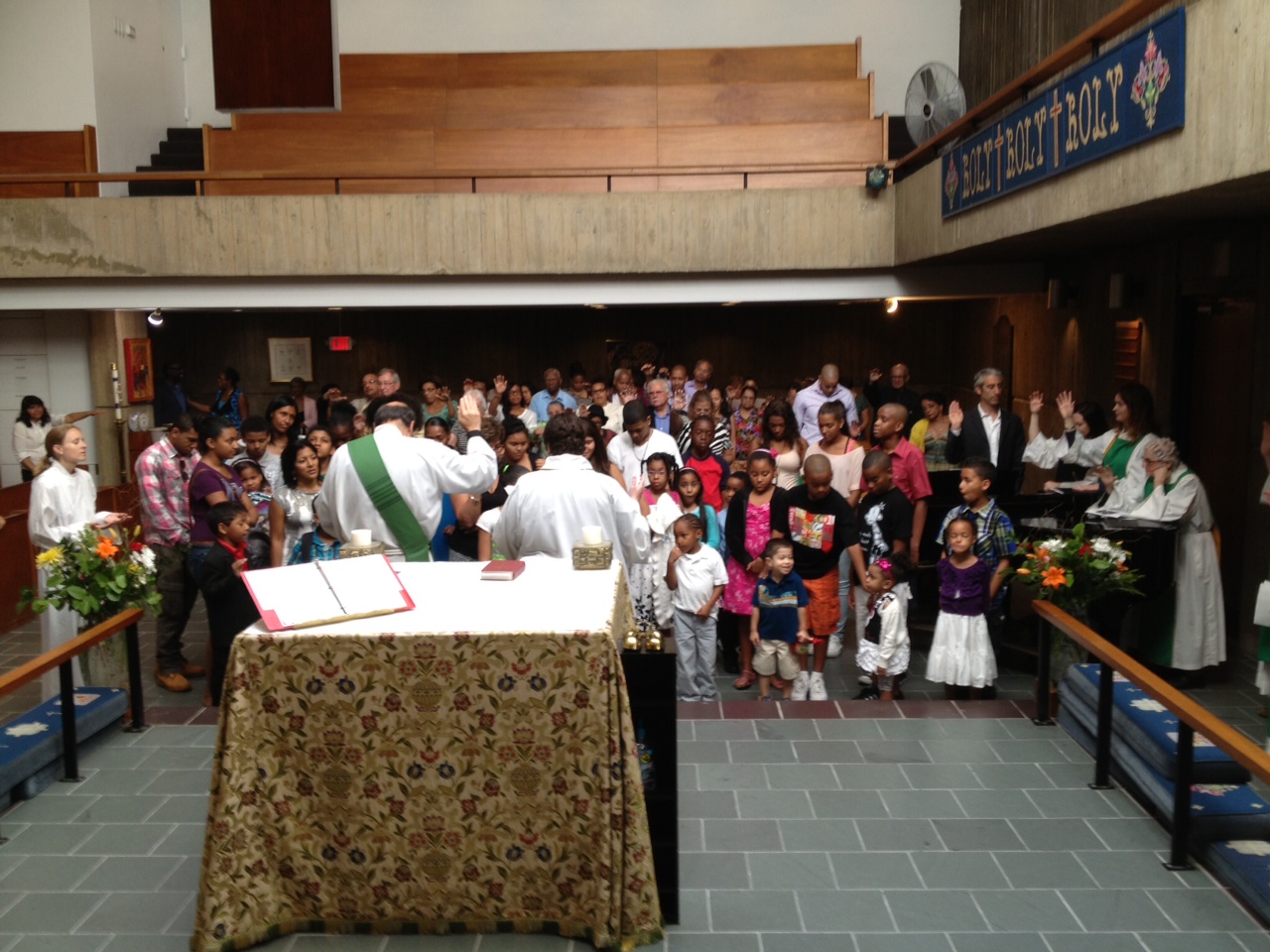
In a few moments we’ll prepare this table for our Holy Communion—all of us, together.  And whether you’re robed at the altar or standing in a pew, you are integral in sharing Christ’s body.  Together we profess a bold faith and pray bold prayers.  Your testimony is just as important as mine, Deacon George’s or Mother Carla’s.  This is our work. But it’s not the end of our work.  We testify to a risen Christ in these walls with one another, and then we continue to bear witness when we “go forth into the world rejoicing.”

Jesus tells us: “This will give you an opportunity to testify.”  Lord, help us to see the opportunities here among us.  Help us to be your resurrected church.  Amen.

*Radical Welcome by Stephanie Spellers is an excellent read.

Tagged , , , , ,

Ser la resurrección

17 noviembre, 2013—Proper 28—Iglesia de San Mateo & San Timoteo, Nueva York

2 Tesalonicenses 3:6–13; San Lucas 21:5–19

Si están familiarizados con la historia de esta congregación, San Mateo & San Timoteo, conocen que el edificio de la iglesia ha sido destruido cuatro veces desde su incepción en 1797.  Este mismo edificio en el cual nos sentamos ahora fue reconstruido en 1969  después de haber sido quemado en 1965.

Si han estado aquí en los últimos 15 años, ya saben que el barrio y la congregación han visto mucho cambio.  Hace menos de 2 años que estoy aquí, pero las 5 semanas pasadas, he escuchado las historias de varias personas en esta iglesia durante nuestras reuniones hablando del libro “Radical Welcome.”

Lo que he aprendido de todos ustedes es que esta iglesia era un lugar seguro cuando había demasiado peligro en el barrio.  Que a un tiempo no se podía caminar desde Columbus Avenue hasta Amsterdam a menos que primero anda unas cuadras al norte o el sur para eludir las drogas y la violencia.  En este tiempo, San Mateo & San Timoteo era un refugio de celebración, adoración, estudios, lenguas y relaciones.

El barrio es un lugar más seguro ahora, pero con el aumento de seguridad viene el aumentado de rentas—hasta que algunos son obligados a irse, o a quedarse, pero se sienten como extranjeros.  Y los cambios han tenido graves consecuencias para nuestro hogar espiritual también.  Miramos alrededor y nos sentimos anémicos—nostálgicos de los días cuando los servicios eran ruidosos con niños y los bancos estaban llenos de amigas.

Nosotros no somos muy diferentes al escritor del Evangelio de San Lucas y la gente que lo habría oído primero.  No se conoce la fecha exacta de este Evangelio, pero muchos estudiosos creen que fue escrito después de la destrucción del templo descrito en nuestra lectura de hoy.  Así que, mientras que Jesús predice la destrucción del templo, la narración de San Lucas está escrito en forma retrospectiva.

Y si la destrucción del templo no era suficiente ya, los versículos inmediatamente después de la conversación de la lectura de hoy hablan de un cambio serio en el barrio—el imperio de los gentiles en lo que era una tierra judía.

El punto es: este mensaje es para nosotros.  Este evangelio es el nuestro.

Jesús dice que el edificio del templo será destruido, cuando no quedará ni una piedra sobre otra.  Esta iglesia ha visto lo mismo.

Dice que nos encontraremos con falso maestros que nos llevan por mal camino.  Nuestro mundo ha conocido muchos.

Dice que las naciones y reinos estarán en guerra, uno con el otro.  Los veteranos que honramos esta semana pueden hablar sobre esa verdad.

Advierte de las epidemias y los desastres naturales.  Recordamos el huracán Sandy el año pasado mientras que oramos por las víctimas de tifón de esta semana en las Filipinas.

Advierte de la traición  del odio y la muerte—una amenaza cada día.

Y aún todo esto, Jesús dice que no pereceremos.  Perduraremos.  Y nos dice que esta es nuestra oportunidad para testificar.

No es fácil dar testimonio cuando el templo está en ruinas y su comunidad es un remanente fiel entre extraños.

Y no estoy tratando de decir que nuestra iglesia ha caído y nuestros vecinos son enemigos.  Esta comparación no es perfecta—y gracias a Dios que no lo es.  Pero es una oportunidad para reconocer los desafíos del tiempo de Jesús y de nuestro propio tiempo, y a escuchar el llamado de Jesús en medio de todo, que nosotros somos la gente de resurrección que proclaman una historia de la resurrección.

Es más fácil testificar cuando las cosas van bien, cuando nos sentimos fuertes y seguros.  Digo a la gente todo el tiempo que yo trabajo en la mejor parroquia con la mejor mentora.  Digo a personas lo maravilloso que son todos ustedes y cómo bienvenida todos me hacen sentir.  Yo les digo que buen trabajo puedo hacer aquí—como trabajar en el “Soup Kitchen” el año pasado, predicar en dos idiomas, facilitar un estudio de libro.  Para mí, haber estado aquí sólo 18 meses en lugar de 18 años, es fácil apreciar el ministerio vibrante de San Mateo & San Timoteo.

Pero tenemos que testificar cuando nos sentimos débiles también, y puedo entender cómo aquellos que han experimentado la transición en nuestra comunidad y en nuestra iglesia pueden sentirse que el testimonio es un trabajo duro.

La carta de Pablo a los Tesalonicenses habla de trabajo duro.  Casi parece que está escribiendo a los empleados de un negocio, pero realmente está hablando a los cristianos en la iglesia primitiva.

Mi frase favorita es, “Pero hemos sabido que algunos de ustedes llevan una conducta indisciplinada, muy ocupados en no hacer nada.” Notan que Pablo no equiparar ser ocupado con trabajo.  Los Tesalonicenses aparentemente estaban muy ocupados en su ociosidad.

Nueve York es un lugar muy ocupado—te lo dice como alguien que claramente no es de aquí.  Mi nivel de actividad ha llegado a el punto más alto, y supongo que se deben sentir muy ocupados como yo.  A veces, estoy tan ocupada que no puedo hacer cualquier trabajo.

Estos son algunos ejemplos:

Cuando estoy tan ocupada preocupada por un examen que no me puedo concentrar en el estudio que debo hacer.

Cuando estoy tan ocupada escribiendo un sermón que olvido escuchar al Espíritu Santo.

Cuando un seminario está tan ocupado por la banca rota que se olvida que es una extensión de la iglesia primero y un negocio segundo.

Cuando estamos tan ocupados preparando la comida para “Soup Kitchen” los domingos que olvidamos de preparar nuestros corazones para servir al prójimo con dignidad y amor.

Cuando estamos tan ocupados extrañando a tal persona que no viene a la iglesia que olvidamos llamar a esta persona para saber como está, o olvidamos preguntar como está la persona que está aquí, presente con nosotros.

A veces estamos tan ocupados lamentando la destrucción del templo que olvidamos a testificar a la promesa de la resurrección.

A veces personas me preguntan por qué estoy entrenando para ser sacerdote cuando iglesias por todas partes están experimentando decaencia.  ¿Dónde está la seguridad del empleo en esto?

La verdad es que estoy entrenando para ser una sacerdote en una iglesia que predica la resurrección—Cristo ha muerto, Cristo ha resucitado, Cristo volverá.  Practicamos la resurrección cada vez que venimos a esta mesa para recibir el cuerpo roto de Cristo, y practicamos la resurrección cuando nos convertimos en lo que recibimos—Cristo vivo en nosotros, en nuestra iglesia, en el mundo.

Y es cierto que nos sentimos débiles a veces.  Pero aquí es donde venimos para la comida espiritual que necesitamos para resistir.  No para ser ocupados, pero para ser testigos de un Cristo resucitado.

En unos momentos preparamos esta mesa para nuestra comunión—todos juntos.  No importa si usted está el el altar o en un banco, eres integral en compartir el cuerpo de Cristo.  Juntos profesamos una fe audaz y rezamos oraciones audaces.  Su testimonio es tan importante como la mía, o de diácono George, o de Madre Carla.  Este es nuestro trabajo.  Pero no es el punto final de nuestro trabajo.  Testificamos a un Cristo resucitado en estas paredes juntas, y luego seguimos dando testimonio cuando vamos adelante en el mundo.

Jesús nos dice: “Esto le dará la oportunidad de testificar.”  Señor, ayúdanos ver las oportunidades aquí entre nosotros.  Ayúdanos a ser la iglesia resucitada.  Amén.

Tagged , , , , , , ,

Marathon Recap

Well it has taken me a while to sit down to write out my thoughts/feelings about Sunday’s race, but that’s partly because it took me a while to process such a huge experience.

Image

Mom, me and Jay at the finishing area the day before the race

I was so much more relaxed going into this year’s marathon.  Jay was quite busy gearing up at work, but Mom was here making soup and cookies while I painted my nails purple.  It was all pretty chill until Saturday afternoon.  Then reality, excitement and fear started to settle in.

I didn’t sleep a wink Saturday night.  Jay got up at 3am to head into work and then to the start village where he’d be field-producing the pre-race coverage.  My alarm was set for 5am, at which point I got dressed, made my UCAN breakfast to drink later, looked over my checklist to be sure I didn’t forget anything, and kissed my mom goodbye.  I walked out the door to find an adorable poster attached to the “wet floor” sign in our hallway thanks to my wonderful neighbor.  I flagged a cab to Union Square where I met up with the rest of the Alzheimer’s team for a 5:45am team picture and a 6am departure.  Our friend Amy from out of town hitched a ride with the team, so I had someone to distract me on the ride over.  I ate my over-night oats and stared out the window.  Once in Staten Island, we had to go through several security checks.  One officer was concerned about the chia seeds in my water, saying it looked like metal balls floating in a bottle (because that’s what metal balls do… they float… right.)  We were not permitted to bring any opaque bags, which included trash bags to sit on, so I just had to hide mine in my pocket.  Really, the list of items you could or could not bring totally depended on the security guard that stopped you.

Once in, Amy and I walked over to where ABC was producing their coverage.  Amy used to work at the station, so she was just as eager to see the news crew as I was.  We got hugs of encouragement during a commercial break, and then it was back to business.  Amy left to find the blue section of the village, and I stayed by the ABC staging area because it happened to be in the green section of the village (and I was in Green Wave #1).  At one point I felt a jacket plop down on me from above and looked up to see Jay on the other side of the barrier, headset still on, mouthing ‘keep warm!’  It was pretty chilly and windy out there.

Image

Amy, Kim, Jay and me at the WABC staging area in the start village

Right before my coral opened, I drank my UCAN and changed my shoes/socks, shedding a few layers and returning Jay’s jacket.  He mouthed from the stage, ‘I LOVE YOU SO MUCH!’ and we waved goodbye.  The corrals were lined with porto-potties and I made two stops for good measure.  Then it was time to line up.  It was cold, but time to strip down to the essentials.  I tried to throw my jacket over to the side of the crowd, but elbowed some woman in the head in the process.  I felt reeeeallly bad about that.

And then I heard, “On your marks, get set, go!”

I said, “That’s it??” and then slowly made my way with hundreds of runners to the start mats.  To my knowledge, there was no clock at the start mats–this proved problematic later.  I had no idea how much time had lapsed since the gun-time, so it was hard to gauge my pace.  The green wave runs on the lower level of the Verrazano Bridge, so I had no satellite reception to help me out.  People following me on their computers had a better sense of how I was running than I did.

I knew my first mile would be slow and my second mile would be fast.  I didn’t try to weave through people.  I just went with the flow and surged when I saw an opening.  It was actually less crowded than I imagined.  And despite rumors that runners on the lower level of the bridge get peed on, I did not see (or feel) any evidence to support the claim.

Coming off the bridge I felt the tongue of my left shoe putting pressure on the top of my foot.  I decided to pull over and adjust, thinking it would be better to lose a few seconds than run uncomfortably 24 miles more.

And then I just ran.  The miles went by quickly.  I was comfortable and kept reminding myself not to go out too fast.  My Garmin would say 8:00 or 7:55 pace, and I’d pull back.  I told myself to save it for Central Park.

Brooklyn gets the prize for best cheering.  The crowds were just awesome.  And the fact that I got to see my friends Becca, Bianca and Nick between miles 11 and 12 gave me something to look forward to and then carry with me.  Every few minutes I’d cross another timing mat and think, ‘Alright friends and family, now you know where I am…’ I especially wondered how Jay was feeling about my splits since he gets concerned as a husband but pushes me as a coach.

At one point I crossed Norman Street in Brooklyn–felt like Aimee was smiling down on me running around the streets of her favorite city.

And then it was time for the Queensboro Bridge.  It’s a beast.  I had run over it twice in the past several weeks, so I was mentally prepared.  Right as I reached the bridge a live band was playing “Eye of the Tiger” and that made me laugh as I started to ascend.  The bridges are the quietest part of the marathon–the only stretches where fans aren’t stacked 5 deep.  But then coming back down the Queensboro bridge, you begin to hear the 1st Ave crowds.  As I ran down the exit ramp, not yet seeing the crowds but hearing them cheer, I blurted out “Holy ****!” It’s that kind of moment.  On 1st Ave I knew my legs were starting to get tired, but also I knew I had less than 10 miles to go.  I started counting the streets as we headed north, knowing I’d see some familiar faces at 88th.

Suddenly my dear friend Tanya was running toward me.  I knew she planned to jump in at 88th, but I was still surprised when it happened.  She had a bib, but it’s just so easy to miss people when you are 1 of millions.  We waved to a bunch of teammates and took off.  Tanya told me my last 5k was a few seconds off pace, so we picked it up.  She filled me in on who had won and how some of our elite friends had fared.  And then she basically distracted, encouraged, and pushed me the rest of the race.  We dedicated miles to my family.  We dedicated miles to her family.  We dedicated miles to things I can’t repeat.  We talked about my Grandma Lucy who I was racing in memory of.  We talked about Tanya’s mother who had purple hair (though she thought it was red) like me.  And really when I say “we talked” I mean I listened to Tanya talk.  She ran ahead to get water or Gatorade for me.  She made me do crazy things like striders (to stretch my legs a bit) and butt kicks (to loosen my quads) and high knees (to make me look silly).  People running near us were probably like ‘who is the girl with so much energy?’ But they didn’t have to wonder for long because while others were slowing down, we were speeding up.

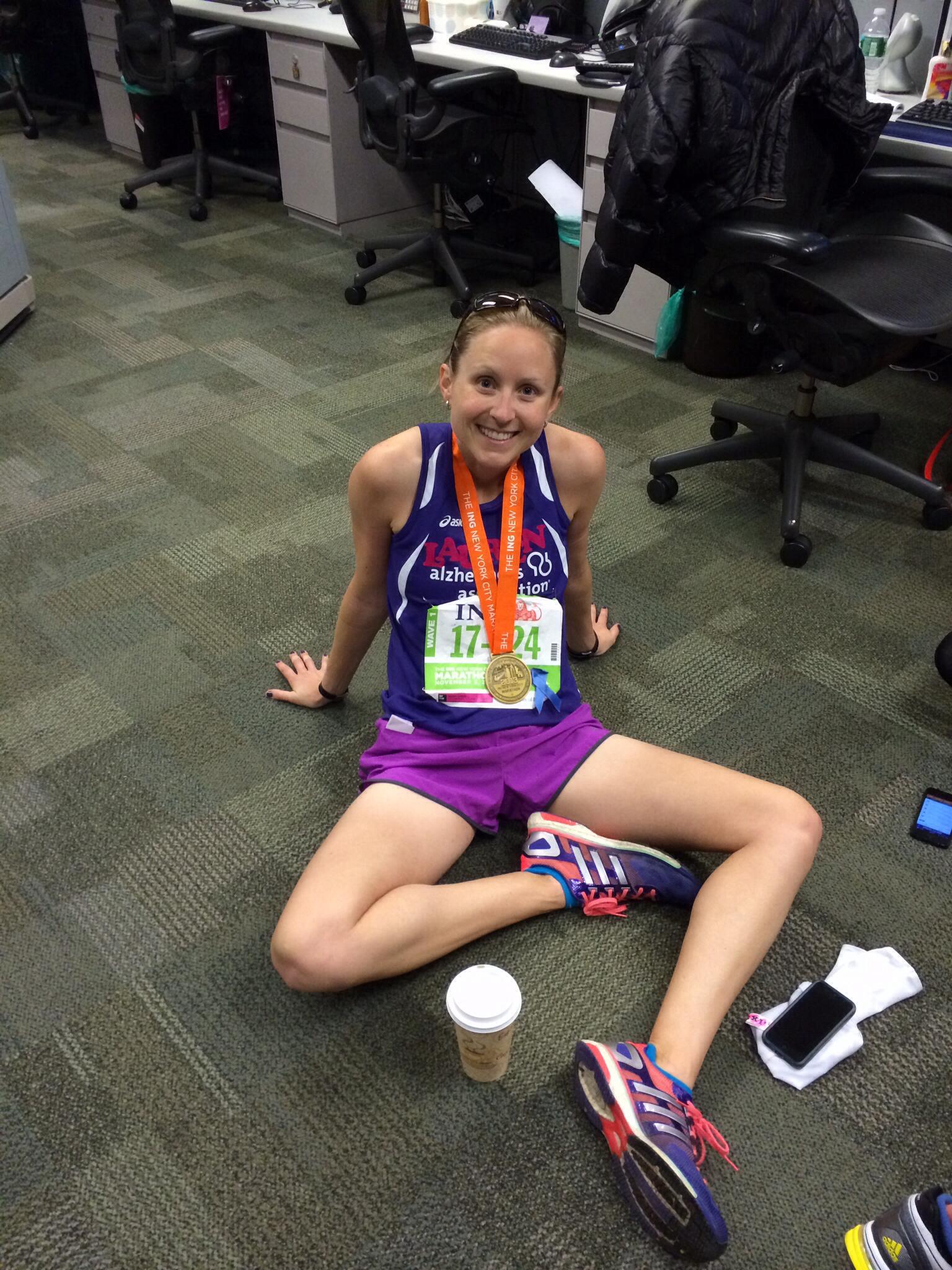
And this is where it gets tricky.  We slowed some on the 3/4 mile slight incline (feels less slight after 20 miles) that is 5th Ave.  Tanya helped me push through by giving me landmarks to strive toward.  Then we turned into the Engineers Gate entrance of Central Park and I knew I was almost home-free.  I run in the park several times a week.  I know every curve, straightaway, up and down.  I was in “lets-do-this” mode.  So Tanya started to pick it up.  It hurt.  But I thought, ‘I can do anything for 3 miles–the faster I run the sooner I’m done.’ And we just kept passing people left and right.  She stopped counting at 50.  At one point she said, “There’s a woman up there with wings on her shoes.”  I looked up and said, “That’s Carol–she’s awesome.”  Tanya ran up beside Carol and said, “I’m running with Lauren.  Come finish with us.”  I caught up and said, “Come with us Carol.”  She smiled and said, “Good job Lauren.”  And we went on.  I knew Carol’s goal was 3:30 and lots of people around us were wearing 3:30 pace bibs as well.  I think Tanya and I both thought we had a BQ in the bag at this point.  Her Garmin was reading sub-8 pace (mine was too, though I didn’t look at it until after the race).  I almost said to her, “We’ve got this, we can cruise in now.”  But I kept quiet and kept pushing.  And we kept getting faster.  We exited at 7th Ave to run along 59th and I could see Columbus Circle up ahead.  “You’re so strong, Lauren.  Give it everything you’ve got!” Tanya said.  We hung a right at the circle and re-entered the park for the home stretch.  I saw the sign for 400 meters, then 300, then 200 (where the shortest and hardest incline of the race is located), then 100… then with arms up in the air and a huge smile, I crossed the finish.  My hips were screaming at me, but I felt amazing.

I walked a few steps, remembered to stop my Garmin, and looked at the screen for the first time in 9 miles.  It said 3:35:11.  I turned to Tanya and said, “My watch has been all over the place, but it’s possible I didn’t break 3:35.”  She pulled out her phone to check my finishing time on the NYCM App… sure enough, 3:35:07.  I threw my arm over her shoulder and said, “Honestly, I didn’t have another 7 seconds in me–If that’s my time, I’m totally happy with it.”  And then she pretty much carried me for a mile of walking, which is impressive if you know how petite Tanya is.

Image

Some non-creepy stranger took this pic of me leaning on Tanya at the finish

We found Jay, beaming with pride, and then my Mom jumping up and down.  I PR’d by over 16 minutes.  It was an amazing race. A-MAZ-ING.  Truly.

Jay, Mom and I swung by the Team Alzheimer’s after-party for an hour or so before I decided I needed to get off my feet and on the couch.  I soaked in the tub and we ordered take-out from Bare Burger.  The further I got from the race, the more obsessed I became with those 7 seconds.

Monday came and I was up early for class.  Mom had to catch her train back to VA and Jay had to head into work.  Before Jay left I said, “If there happen to be any marathons close by in the next few weeks…” He said, “My wheels are already turning.”

That night I went to the Team Alzheimer’s happy hour to celebrate all we had accomplished together–raising over $435,000 is pretty awesome!  I was especially eager to hear about the races for our several first-timers.  You only get one first marathon.

Talking to the team coaches, we all agreed that I ran a great race but probably went out too conservatively and had too much left in the tank at the finish.  One coach suggested I run the Rohoboth Beach marathon in 4 weeks and even offered to pace me since he’s running it (for fun) anyway.  I texted Jay as I left the bar: “DE in 4 weeks.” He responded, “I know.  Tanya and I talked about it.”  And then proceeded to tell me they’d both go and run with me if I wanted to do it.  With two beers and 3 sliders in my belly, I was feeling confident.  Walking home I pretty much decided my body could handle it, I’m healthy, and it’s sure as heck easier to run another in 4 weeks than it is to train countless hours for a race next year.  I told myself I’d wait till my massage the next day to see if Leslie thought my legs were up to the challenge.

But the next day I woke up and felt differently.  Instead of stewing over 7 seconds, I started to relish in the freedom of no training, no plan, and no goals.  I reflected again on how awesome my race was, how hard I pushed and how happy I was with the results.  I thought more about why the 7 seconds were nagging me and realized it had more to do with whether or not I was measuring up to my friends’ expectations and less to do with my own priorities and expectations.  And as soon as I realized that, I realized just how silly the notion was, knowing that 7 seconds wasn’t going to make a lick of difference to my friends, and those measurements were a figment of my imagination.  By the time Leslie told me my legs were in better shape than anyone she’d seen all week, it didn’t even matter.  I’d already made up my mind to stay thrilled with my race and leave the BQ behind.

Here’s what I know: I wanted to run a race that would make Grandma Lucy proud, and I did that.  I noticed things that made me laugh, I thought about things that gave me courage, I sung songs in my head that she would love.  I ran a huge PR, made new friends that are as passionate about ending Alzheimer’s as I am, and raised a lot of money with a lot of help.  I had a freakin’ blast doing it.  Nothing could top Sunday’s race.

Image

A super happy runner after a super awesome race!

I also know I need to catch up on some reading before exams arrive.  I need to take a break from running so as not to burn out.  I have a big year ahead of me, full of transition and discernment.  And I have some other dreams to chase after.

I said Sunday that not qualifying for Boston meant I could hang up my marathoning shoes.  And that’s very true.  But while I meant “for good” when I said it, I know there’s a good chance I’ll run another some day.  And if I want to run Boston, I’ll do what I’ve always done and run for charity.  Some people need a BQ.  I need a cause.  It’s the cause that makes me lace up my shoes on days I want to sleep in, not the PR.  So who knows… the world isn’t going to run out of causes any time soon, so I won’t likely run out of miles.

Till then, it’s been real.  Thank you Team Alzheimer’s.  Thank you friends and strangers along the course.  Thank you friends, family and strangers who donated to end the disease that stole my Grandma.  Thank you UA coaches and teammates.  Thank you Brian and Glen for your wisdom and perspective.  Thanks SMST Church for the posters that I missed.  Thanks Keegan and Kaylee for the home videos of support.  Thank you Tanya for inspiring and pacing me in the race of a lifetime.  Thanks Mom for coming up, cooking, and keeping me calm the way only a mom can.  And thanks Jay for coaching me through a very difficult semester and loving me through it all–you’re my biggest cheer leader and I can’t wait to be yours again in April (slash every day of our lives).

Tagged , , , , , , ,

Marathon Pre-Cap

The butterflies have officially set in.  This time tomorrow I’m hoping to write a race re-cap, but thought it might be interesting to begin with a pre-cap so I have a benchmark of sorts. 

All week I’ve been comparing this year to last year…

Last year I was nervous about running 26.2 for the first time.  This year I know I can finish.  I feel like I trained harder last year, but that’s because training was so new.  This year I feel like I trained about the same amount, but I know I’m stronger and more comfortable.  Last year I was nursing hamstring tendonitis.  This year my body is healthy.  Last year I was mourning the very recent loss of a dear friend in whose memory I was running, so emotions were high.  This year I’m running in memory of my Grandmother, whose loss I have been grieving for years and years as Alzheimer’s stole her away slowly.  It’s different.  And perhaps most significantly, last year I ended up running a race two weeks later than the one I trained for.  This year I am on schedule and sleeping in my own bed with power, heat, and hot water, and no fear of angry bystanders throwing objects at me on the course. 

My goal is to run 3:34:50.  That would be a BQ for me.  The number sounds doable when I look at all my other races and workouts.  Mentally I know I should be able to do this.  BUT 3:34:50 means running 26.2 miles at 8:12 pace, and that sounds crazy.  I just can’t comprehend maintaining that pace–totally boggles the mind.  So I’ll try to focus on the finish time and not dwell on the pace.  Trust the training, trust my beloved coach (as well as my Team Alzheimer’s and UA coaches–I’ve got a lot of support!), trust the race-day magic.

Tomorrow’s main objective is to have fun and run a race that my Grandmother would be proud of.  I know she’d rather I take in the full NYC Marathon experience than beat myself up over pace, so I promise to honor her in that.  Team Alzheimer’s doesn’t take the idea of a “Run to Remember” lightly, and neither do I. 

Time for bed.  Early start to a long day awaits.  Tucking myself in with lots of prayers and love I am feeling from near and far.

Goodnight, and GodSPEED!

Tagged , , ,

Teresa, Salt & Light

Preached at the Chapel of the Good Shepherd at the General Theological Seminary on the feast of St. Teresa of Avila

Romans 8:22-27, Matthew 5:13-16

Have you ever met someone who really loved his or her faith?  Someone with such a passion for their God and their worship that it almost struck you as a little odd, but also made you hope for a taste of a love so personal and profound?  I have encountered several such people. 

My middle school friend Aaron was the first person I knew to wear a kippah and tallit with tzitzit (or fringes) to school.  Growing up in the foothills of Virginia, in a town without a synagogue, Aaron’s Jewish faith already made him a bit of an anomaly.  But his attention to prayer and spiritual practice as a teenager is what made him stand out to me.  He showed me how to tie the tefillin on my head and my arm according to the Shema: Sh’ma Yisra’eil Adonai Eloheinu Adonai echad… These were not just words or motions or traditions or cultural practices—Aaron exhibited genuine piety, joy and palpable faith that I found both curious and inspiring.

And then there was my roommate in Baltimore who was born and raised in a Catholic home and in Catholic schools.  Despite her liberated theology that might make some turn from the church in frustration—my friend’s immense love for the sacraments kept her grounded and hopeful.  She once described to me the intense intimacy she experienced during the Mass, blushing as she described the climax she felt when receiving the Body and Blood of Christ.  Her depiction was so beautiful and vulnerable and bizarre to me—it left me wanting more—wanting a love for God that would make me blush.

Teresa of Avila was one such Saint.  A Carmelite Nun, a Mystic, a Reformer, and one of only two women declared a “Doctor of the Church,” Teresa’s love of God was one of ecstasy and joy.  A love as curious as it was inspiring.  She received visions, she conversed with Christ, she levitated during prayer, and the story of her heart being pierced by an angel with a golden spear is so sensual, only Bernini could capture her ecstasy in sculpture.[1] 

Teresa describes the encounter thus:

In his hands I saw a great golden spear, and at the iron tip there appeared to be a point of fire.  This he plunged into my heart several times so that it penetrated to my entrails.  When he pulled it out, I felt that he took them with it, and left me utterly consumed by the great love of God.  The pain was so severe that it made me utter several moans.  The sweetness caused by this intense pain is so extreme that one cannot possibly wish it to cease, nor is one’s soul then content with anything but God… So gentle is this wooing which takes place between God and the soul that if anyone thinks I am lying, I pray God, in His goodness, to grant him some experience of it.[2]

All this talk of penetration, consummation, sweetness and wooing.  No wonder Teresa says, “When this pain of which I am now speaking begins, the Lord seems to transport the soul and throw it into an ecstasy.  So there is no opportunity for it to feel its pain or suffering, for the enjoyment comes immediately.”[3]

You can imagine that writings such as this raised quite a few eyebrows in the church.  Teresa’s unbridled passion for God meant she faced the inquisition and imprisonment, but it also led to the establishment of 17 convents of Reformed Carmelites.  She was a spirited troublemaker, a reformer and a true lover of God.  And I, for one, really like her. 

Teresa had what Matthew’s gospel describes as “salt” and “light.”  

Honestly, I can’t hear today’s gospel passage without breaking into song.  I often have a mental soundtrack for projects and papers and sermons I’m ruminating on.  Some of you have even seen me break into song over the refectory menu.  This week’s soundtrack has been a mixture of Godspell’s Broadway musical rendition of “Let your light so shine before men…” and the Spanish Taizé chant attributed to Teresa, “Nada te turbe, nada te espante…”

So lets start with the upbeat Broadway tune.  Jesus says, “You are the salt of the earth.”  But he says if salt has lost its saltiness, it might as well be thrown out and trampled on.  Jesus is telling us: be salty!  Be that which adds flavor to life.  Spice it up.  It’s amazing what a pinch of salt can do.  Rather than being a flavor all it’s own, salt is known for enhancing the flavors it is mixed with.  That’s why you can add salt to just about anything—even chocolate chip cookies.  Teresa clearly exhibited salt.  Her life and her visions added flavor to the convents she reformed and to the people who continue to seek out her teaching and writings on prayer and contemplation.

Jesus also tells us, “You are the light of the world,” and he compares us to a city on a hill.  You can’t hide if you’re on a hill, and neither should you hide your light.  Jesus is telling us: get out there and shine!  Don’t “hide it under a bushel, NO!”  We can’t hide our light in these chapel walls.  We can’t hide our light on The Close.  We’ve got to get outside those gates and get shining.  I mean that!  I know most of you well enough to say you are lights in this community and in my life.  And that’s great.  But Jesus says, “You are the light of the world.”  The world!  Teresa took her light on the road, and so should we.

What does all this salt and light have to do with Teresa’s prayer sung at Taizé?  “Let nothing disturb you; nothing frighten you.”  Well being salty and letting your light shine takes courage.  And Teresa would know.  To really let the earth get a taste of who you are and to really let the world see your light shine, you’ve got to be willing to put yourself out there. 

Do you sometimes feel like you need an extra dose of courage just to be yourself?  Do you feel like you’re under the microscope as you journey along this path of discernment and vocation?  I feel that.  I need that courage.   The call to be salt and light is a call to boldness, because it is a call to vulnerability.  And Lord knows vulnerability isn’t for the weak.

A dear friend and colleague here gave me this prayer card of St. Teresa just last week—not because I’d be preaching on Teresa this week, but because Teresa’s prayer is one I need to contemplate daily as a senior. 

In a moment we’ll sing a version of this same text, so pay attention to the words.  Perhaps it can be your prayer too:

Let nothing disturb you; nothing frighten you.

All things are passing.

God alone never changes.

Patience obtains all things.

Nothing is wanting to him who possesses God.

God alone suffices.


Amen. 

Take courage.

And get shining!


[1] See The Ecstasy of Saint Theresa by Giovanni Lorenzo Bernini (1598-1680), in the Cornaro Chapel, Rome.

[2] The Life of Saint Teresa of Avila by Herself, pg 210.

[3] The Life of Saint Teresa of Avila by Herself, pg 211.

Tagged , , , , ,

Preaching Paradoxes

Preached at the Church of St. Matthew & St. Timothy in New York City

September 8, 2013—Grandparents’ Sunday

Proper 18: Luke 14:25-33

I was so excited when Mother Carla told me I would get to preach for Grandparent’s Sunday.  My grandparents are such an integral part of my life.  I know many of you in this church are here because your grandparents come here, or else they were part of this community before they joined the community of saints.  Our relationships with our grandparents are unlike any other—it is a love so generous and so full.  It’s a love that knows the wisdom of a lifetime of love.  Grandparents are the best.

Estaba tan alegre cuando Madre Carla me dijo que podría predicar el domingo de los abuelos y las abuelas.  Mis abuelos son tan importantes en mi vida.  Yo sé que muchos de ustedes en esta iglesia están aquí porque sus abuelas vienen aquí.  O tal vez sus abuelas eran parte de esta comunidad antes de reunirse con la comunidad de santos.  Las relaciones con nuestras abuelas son diferentes de cualquier otra—es un amor tan generoso y tan completo.  Abuelos y abuelas son los mejores.

Grandparent's Sunday was also the "blessing of the backpacks" as kiddos prepared to go back to school.

Grandparent’s Sunday was also the “blessing of the backpacks” as kiddos prepared to go back to school.

So imagine my dismay when I read this morning’s gospel lesson!  According to Luke, Jesus says, “Whoever comes to me and does not hate father and mother, wife and children, brothers and sisters, yes, and even life itself, cannot be my disciple.”  Well thanks a lot, Luke.  And thank you too, Jesus.  So many passages in the Bible about Love and family… and I get this.

Así que imagínense mi consternación cuando leí la lección para hoy.  Jesús dice: “Si alguno viene a mí y no me ama más que su padre, a su madre, a su esposa, a sus hijos, a sus hermanos y a sus hermanas, y aun más que a sí mismo, no puede ser mi discípulo.”  Pues, muchas gracias, Lucas.  Y gracias a ti también, Jesús.  Cuantos pasajes hay en la Biblia sobre amor y familia… y me toca este.

But believe it or not, I think this passage is about love.  I think it’s safe to say that Jesus isn’t trying to tell us that family is bad.  If we look at the Ten Commandments, “honor your father and mother” is right up there with “do not kill,” so clearly God cherishes our family relationships and the responsibilities they call us to.  While I don’t think Jesus is saying that family is bad, I do think he is making a very difficult point: that we have to be willing to lose it all—and he uses family to illustrate what’s at stake—we have to be willing to lose it all if we are to be disciples of Christ.  To take up that cross takes both hands—we can’t hold on to anything else.

Aunque el pasaje es difícil, yo creo que tiene que ver con el amor.  No creo que Jesús quiere decir que la familia es mala.  Los Diez Mandamientos nos dicen “honren a su padre y madre” a lado de “no maten.”  Claro que Dios aprecia a nuestras familias y las responsabilidades de nuestras relaciones.  Aunque no creo que Jesús dice que la familia es mala, creo que quiere hacer un punto muy difícil: que tenemos que estar dispuestos a perderlo todo, y Jesús usa la familia para ilustrar lo que está en juego—tenemos que estar dispuestos a perderlo todo si queremos ser discípulos de Cristo.  Para tomar esa cruz, necesitamos ambas manos—no nos podemos agarrar a dos cosas a la vez.

Indeed two chapters later in Luke’s gospel Jesus tells us, “No slave can serve two masters; for a slave will either hate the one and love the other, or be devoted to the one and despise the other.”[1]

Dos capítulos más tarde en el evangelio de Lucas, Jesús nos dice, “Ningún sirviente puede servir a dos amos; porque odiará a uno y querrá al otro, o será fiel a uno y despreciará al otro.”

Gosh, “hate” is such a strong word—especially when it’s connected to the greatest love story—of Christ giving up his life for us in love.  Clearly this love is not just the warm-fuzzy love we like to think about; but rather the counter-cultural, radical, crazy risky love that takes everything we’ve got.  And Jesus has the wisdom of a Grandparent to tell it to us straight—to be upfront about the challenges and the hurt and even death that lies ahead—so that our decision to take up this cross can be an informed one.

“Odio” es una palabra muy fuerte, especialmente cuando tiene que ver con la historia del amor más grande—la historia de Cristo quien da su vida para nosotros en el amor.  Claro que este amor no es un amor fácil.  Es un amor riesgoso, contracultural, radical, y loco—un amor que toma todo que tenemos.  Y Jesús tiene la sabiduría de un abuelo para decírnoslo directamente—para ser sincero sobre los desafíos y el daño y quizás la muerte que nos espera—para que nuestra decisión de tomar esta cruz puede ser informada.

It’s a bit of a paradox to hear about and preach about turning your back on your family on grandparent’s Sunday.  And I think there’s a paradox in this all-or-nothing love we’re called to too.  I’ll share with you something I read by C. S. Lewis many years ago that has stuck with me.  He says, “When I have learnt to love God better than my earthly dearest, I shall love my earthly dearest better than I do now. In so far as I learn to love my earthly dearest at the expense of God and instead of God, I shall be moving towards the state in which I shall not love my earthly dearest at all. When first things are put first, second things are not suppressed but increased.”[2]

Es un poco paradójico oír y predicar sobre esta pasaje el domingo de los abuelos y abuelas.  Y creo que hay una paradoja en este todo-o-nada amor que nos llama también.  Quiero compartir algo que leí de C. S. Lewis hace unos años.  Él dice, “Cuando he aprendido a amar a Dios mejor que los más querido por mí en la tierra, amaré a lo más querido en la tierra más que ahora.  Pero cuando aprendo a amar lo más querido en la tierra a detrimento y en vez de Dios, me estaría moviendo hacia no amar lo más querido por mí en la tierra.  Cuando las cosas primeras se ponen primeras, las cosas segundas no se suprimen, pero se aumenten.”

Who is your “earthly dearest”?  Is it your Mom, your brother, your spouse, your children, your best friend, your grandparent or grandchild?  Does the thought of turning your back on them to follow Jesus scare you or make you feel uncomfortable?  Me too.  But I’ve seen the love of Jesus at work in my life and in the lives of others—it’s a love bigger than I can fit in this sermon or even put into words.

¿Quién es su más querida o querido?  ¿Es su madre, su hermano, su esposa, sus hijos, su mejor amigo, sus abuelas o nietos?  ¿La idea de darle la espalda a ellos para seguir a Jesús le asusta o que se sienta incómodo?  Yo también.  Pero he visto el amor de Jesús en mi vida y en la vida de los demás—es un amor más grande del que puedo poner en este sermón—más grande que muchas palabras. 

Again and again we read in the Bible that we are to love God above all else. For me, this is a daily struggle—and I can tell you that I often love my family or even myself more than I love God.  I think maybe prophets and Jesus and disciples make this point repeatedly because we need constant reminders.  And so today, on Grandparents’ Sunday, I invite you into the hard work of following Jesus—of putting God first.  Of putting first things first so that the second things are increased.  Of risking loving God most so that we may love our neighbor—and our families—more.

Una y otra vez leemos en la Biblia que necesitamos amar a Dios más que a todo.  Para mí, es una lucha diaria—y puedo decirles que a menudo amo a mi familia o a mí misma más que amo a Dios.  Pienso que tal vez los profetas y Jesús y los discípulos hacen este punto varias veces porque necesitamos recordatorios constantes.  Así que hoy, en el domingo de los abuelos y abuelas, les invito al trabajo duro de seguir a Jesús—de poner a Dios primero.  De poner las cosas primeras primero, para que las cosas segundas se aumenten.  De arriesgar amar a Dios al máximo para que podamos amar a nuestro prójimo y nuestras familias más.


[1] Luke 16:13.

[2] C.S. Lewis, Collected Letters, Volume III.

Just Do It

This sermon was preached at the Preaching Excellence Conference in Richmond, VA

Using the lectionary for the third Sunday of Epiphany, Year B

Jonah 3:1-5, 10; Psalm 62:5-12; 1 Corinthians 7:29-31; Mark 1:14-20

I love that today’s readings in Jonah and Mark were paired together because I love the sense of immediacy and urgency they both conjure up.

First we have Jonah—a story every Sunday school child can recount.  God tells Jonah to go to Nineveh, Jonah runs the other way, Jonah is swallowed up by a fish, Jonah is spit out onto the shore, and here we have God telling Jonah a second time—the only prophet who needs telling twice—go to Nineveh and tell the people to change their ways.  And perhaps more remarkably than Jonah’s 3-day residence in a fish’s belly, the Ninevites repent!  Really!  Jonah says, “Watch out, Nineveh will be overturned!” And boom—the people believe, fast and repent—just like that.  They change their ways, God changes the divine mind, and no one is destroyed.

Then we have Mark’s Gospel.  Mark doesn’t start his gospel with the story of Jesus’ birth, but with the story of Jesus’ ministry.  And here in the first chapter we have Jesus’ first words: “The time is fulfilled, and the kingdom of God has come near; repent, and believe in the good news.”  Then, walking along the Sea of Galilee, Jesus says to fishermen Simon and Andrew, “Follow me and I will make you fish for people.”  And boom—Simon and Andrew drop their nets right where they are and immediately follow Jesus—just like that.

A fisherman in Ganvie, Benin.  Taken when I lived in West Africa.

A fisherman in Ganvie, Benin. Taken when I lived in West Africa.

To read these two stories side-by-side is almost comical because the immediate belief and response of the Ninevites and fishermen is so contrary to our own skeptical world.

I mean, really, if a total stranger were to walk up to one of us on the street and hand us a $100 bill for no particular reason, chances are we wouldn’t respond, “Gee, thanks!” but “What’s the catch?”

I have been racking my brain for several days, trying to think of a situation in which I would drop everything and respond with the immediacy of the Ninevites and fisherman.  But most of the situations I can think of are either from childhood, when faith is a way of life before skepticism creeps in, or from times when I felt absolutely trapped and desperate for a way out.

Perhaps the Ninevites felt trapped and desperate when Jonah proclaimed, “Forty days more, and Nineveh shall be overthrown!”  Perhaps they believed, fasted and put on sackcloth because the alternative was too grim.  Perhaps.  But why would a people so evil and set in their ways heed the call of a prophet like Jonah?

The fishermen are a different story.  They weren’t trapped.  They weren’t desperate.  Fishing was a good trade in Jesus’ day.  And yet they weren’t children either, filled with wonder and quick to believe.  They were adults working in the family business.  So why would they leave their nets, their job and their family to follow Jesus?

What could be compelling enough to make them follow?  What would be compelling enough to make you or me follow?

I think the answer for the disciples and for us must be: the good news—that the kingdom of God has come near.  And not the kingdom of God as in a place, or a thing—but as in the reign of God in our lives.

But what does that mean?  How do we describe this good news?  This kingdom of God?  Preachers are meant to proclaim the good news—so what is it?

When I think of the good news of God’s reign, I have to turn to Isaiah:

he has sent me to bring good news to

the oppressed,

to bind up the brokenhearted,

to proclaim liberty to the captives,

and release to the prisoners…

to comfort all who mourn…

to give them a garland instead

of ashes,

the oil of gladness instead of

mourning,

the mantle of praise instead of a

faint spirit.

They will be called oaks of

righteousness…

They shall build up their ancient ruins…[1]

If this sounds familiar, perhaps it’s because the first part of this passage is precisely what Jesus in Luke’s gospel chooses to read in the synagogue on the day he proclaims his public ministry, saying, “Today this scripture is fulfilled in your hearing.”

“He has sent me to bring good news to the oppressed,” we read in Isaiah.  “The time is fulfilled, and the kingdom of God has come near; repent, and believe in the good news,” says Jesus in Mark’s gospel.

This is what’s compelling.  Broken hearts are mended.  Captives are set free.  Prisoners are released.  And those who mourn are comforted, anointed with the oil of gladness and decorated with garlands.  That which has been ruined is rebuilt and repaired—the oppressed are lifted up.

If you’ve ever felt broken or trapped or stepped on or grief stricken, this is indeed good news.  This good news is for you.

But here’s the catch: the good news for you is also your good news to proclaim.  The fishermen didn’t just hear Jesus and say, “Why yes, that is good news!” and then keep on fishing.  They dropped their nets and followed.

We cry out to Jesus saying, “Me!  Me!  Mend my broken heart!”  And thank God we do.  But once this kingdom of God draws you in and you experience the love that God is, watch out—it is not a love that lets us sit on our hands and watch the world pass by.  This love we receive, this liberation we experience, it is a call to action.

If you believe in this good news, you best be looking for broken hearts to bind up.  If you believe in this good news, you better start recognizing who the captives are and start working to set them free.  If you believe in this good news, get ready to rebuild what has been torn down.

The good news is messy and it is edgy and it is worth dropping our proverbial nets so we can follow the one who gives it to us.

“Believe in the good news…follow me.”

I know we’re a skeptical people.  I know we have our doubts.  But if the Ninevites and the fishermen can believe and be transformed by their belief, maybe we can too.  This good news is just as much ours as it was theirs—ours to live and ours to give.

God, help us make it so.  Amen.


[1] Isaiah 61:1-4

Tagged , , , ,

Escuchando El Espíritu

5 Mayo, 2013—Pascua 2C—Iglesia de San Mateo & San Timoteo, Nueva York

Hechos 11:1-18; Salmos 148; Apocolipsis 21:1-6; San Juan 13:31-35

La semana pasada, Madre Carla nos dio una tarea.  ¿Se acuerdan? Ella nos animó a pensar del amor cuando hacemos decisiones—a preguntarnos cuál es la respuesta de amor, y a actuar de ese amor.

Pues, ¿Cómo les fue?

¿Amaron a sus vecinos?  ¿Se Amaron a si mismos?  ¿Se preguntaron, cuál es la manera más amorosa en que puedo hacer en esta situación?

Leí en un libro esta semana que, “Cuando Jesús nos llama a amar a nuestro prójimo como a nosotros mismos, nos dice que realmente no podemos amar a ninguno sin amar a ambos.”  Si no me amo, será difícil amar a otro/a.  Y si yo no soy amoroso hacia usted, será difícil a amarme a mí mismo.*

La semana pasada el Evangelio de Juan nos recordó cómo la gente sabría que somos discípulos de Cristo, “que se amen los unos a los otros.”

Esta semana Jesús nos dice que él enviará el Defensor, el Espíritu Santo—antes Jesús describe al Consolador como “el espíritu de la verdad…está con ustedes y permanecerá siempre con ustedes.”  Aquí Jesús nos dice que el Defensor es una gracia de Dios, enviado en nombre de Cristo.  Nos dice que este Espíritu nos enseñará todo y nos recordará todo lo que él nos ha dicho.

Y esto es lo que quiero explorar con ustedes hoy, ¿cómo conocemos y cómo escuchamos al Espíritu Santo?  Porque creo que conociendo al Espíritu Santo realmente informa nuestra capacidad de amarnos unos al otros.

Holy Spirit Coming, by He Qi.

Para comenzar, ¿cuáles son algunos nombres que tenemos para el Espíritu Santo?  El texto de hoy llama al Espíritu un Defensor.

Maestro

Ayudante

Consolador

Pneuma/Ruach—viento o aliento en griego/hebreo

Intercesor—que ora en nuestro nombre

Estos nombres nos ayudan a conocer lo que hace el Espíritu.  Y saber lo que el Espíritu hace nos ayuda a reconocer al Espíritu en nuestras vidas.

Hay un libro llamado “El ayudante” sobre el Espíritu Santo que leía cada año para la Cuaresma.**  El libro es más viejo que yo, y usa unas palabras que ya no estamos acostumbrados a usar.  Pero lo leía cada año porque me enseña a practicar escuchar al Espíritu.

Empezamos con lo que acabamos de hacer—decir quien es el Espíritu Santo para que sepamos a quien escuchamos.

Entonces hablamos de donde encontramos el Espíritu Santo.  Jesús dice, el Espíritu Santo está dentro de usted.  Para mí, siento el Espíritu Santo en mis huesos. Para otros, puede ser su corazón o su cabeza.  Sin embargo, encontrar el Espíritu Santo requiere un conocimiento de sí mismo que viene de una inteligencia interior.

Cuando sabemos a quien escuchamos, y como escuchar, podemos practicar el escuchar.

Generalmente necesitamos empezar poco a poco.  Preste atención a los pequeños impulsos, avances, pausas y provocaciones.  Tal vez siento que debo llamar a un amigo, que debo mandar un texto a mi esposa para recordarle como le amo, que debo quedarme en casa para descansar y luego de asistir a un evento.

Tenemos estos presentimientos pequeños y nos preguntamos si deberíamos prestar atención a ellos, no?  Esto es cuando comienza el estar escuchando al Espíritu Santo.

No siempre entiendo un presentimiento, y no siempre sé si seguir este instinto realmente hiciera una diferencia en mi día o en el día de alguien más.  Pero nos inculca el hábito de escuchar, confianza y actuar.

Según se pone en práctica, es posible que a veces me pregunte ¿cómo sé yo si estoy escuchando al Espíritu Santo, y no algún otro impulso o influencia?

Recuerden que Jesús dijo que el Espíritu Santo nos recuerda todo Jesús nos ha enseñado.  Así que, como Jesús, el Espíritu Santo nos anima a actuar de tal manera que nos amemos los unos a los otros.  A veces escuchando por el amor nos ayuda a eliminar cualquier otras distracciones.

Cuando nos acostumbramos a escuchar al Espíritu Santo en las cosas pequeñas, podemos confiar en la misma voz cuando encontramos decisiones más grandes.  Quizás es tiempo de moverse, tomar un riesgo en el trabajo, quitar una relación malsana, empezar una familia, elegir una universidad después de colegio, o asumir una nueva responsabilidad.  Si hemos practicado escuchar al Espíritu Santo, ya sabemos la voz tranquila en situaciones grandes y pequeñas.

Esta capacidad de conocer y confiar en el Espíritu Santo es la razón que Jesús pueda decir, “Al irme les dejo la paz.  Les doy mi paz, pero no se la doy como la dan los que son del mundo.  No se angustien ni tengan miedo.”

Jesús dice esto ya que está a punto de irse de este mundo.  Él sabe que los discípulos pronto se enfrentaran con temor y dudas.  Pero porque el Espíritu Santo permanece, el mismo Espíritu de Dios que Jesús ha encarnado en la tierra para nosotros, nunca estamos solos y no tenemos nada que temer.

Mientras más conocemos el Espíritu Santo, cuanto más conocemos la paz de Cristo.

Creo que esta paz es doble.  Creo que hay una paz que experimentamos al actuar con la seguridad del Espíritu Santo.  Creo que es una paz que sobrepasa nuestra comprensión porque a veces el Espíritu nos llama a hacer cosas fuera de lógica.

Pero también hay la paz que se crea cuando hacemos lo más amoroso como Madre Carla nos desafió que consideremos la semana pasada.

La paz que Jesús nos deja es una paz que experimentamos y que creamos cuando escuchamos al Espíritu y nos amamos unos a otros.

Pasé mucho tiempo hoy hablando de cómo escuchar por el Espíritu porque creo que es algo que tenemos que entrenar nuestros oídos a hacer.  Tanto como podríamos creer que el amor debería venir fácilmente, el amor es algo que Jesús nos enseña una y otra vez, sermón después de sermón, parábola después de parábola, y por último con su muerte y resurrección.  Y Jesús nos dice, “el Espíritu Santo les enseñará todas las cosas y les recordará todo lo que les he dicho.”  Así que, si debemos amar el uno al otro, tenemos que practicar escuchando al Espíritu.

En dos semanas celebraremos Pentecostés.  Pentecostés es cuando recordamos la venida del Espíritu Santo que autorizó a los discípulos a predicar vigorosamente y en lenguas que nunca habían hablado antes.  Pentecostés es el domingo del Espíritu Santo.

Pero si queremos que nuestros corazones sean encendidos con el poder del Espíritu Santo, tenemos que estar abiertos y listos para escuchar.

Practiquen conmigo.  Empiecen con lo pequeño y prepárese para algo grande.  Nunca se sabe a que valentía el Espíritu le podría llamar, pero puede confiar en que será una llamada de amor y paz.

Amen.

*L. William Countryman, Living on the Border of the Holy: Renewing the Priesthood of All, page 176.

**Catherine Marshall, The Helper.

Tagged , , , , , ,

Listening for Fire

Preached on the Sixth Sunday of Easter at St. Matthew & St. Timothy, New York

Acts 11:1-18; Psalm 148; Revelation 21:1-6; John 13:31-35

Last week Mother Carla gave us some homework.  She encouraged us to think of Love as we made decisions—to ask ourselves what the loving response might be and to act out of that love.

How’d it go for you?

Did you love your neighbor?  Did you love yourself?  Did you ask yourself, what is the most loving thing I can do in this situation or that?

I read in a book this week that, “When Jesus calls us to love our neighbor as ourselves, he is telling us that we cannot really love either without loving both.”[1]  If I don’t love myself, I’m going to have a hard time loving you.  And if I’m not very loving toward you, it’s going to be tough to love myself.

Last week John’s gospel reminded us how people would know we are disciples of Christ, “that you love one another.”

This week Jesus tells us that he will send the Advocate, the Holy Spirit—earlier Jesus describes the Advocate as “the spirit of truth…he abides with you, and he will be in you.”[2]  Here Jesus tells us that the Advocate is a gift from God, sent in Christ’s name, and that this Spirit will teach us everything, and remind us of all that Jesus has said to us.

And this is what I want to explore with you today—how we know or listen to the Holy Spirit—because I think knowing the Holy Spirit really informs our ability to love one another.

Jyoti Sahi- India

So first off—what are some names we have for the Holy Spirit?  Today’s text calls the Spirit an Advocate.

Teacher

Helper (Paraclete)

Comforter

Pneuma/Ruach—wind or breath in Greek/Hebrew

Intercessor—groans on our behalf

These names help us to know what the Spirit does.  And knowing what the Spirit does should help us to recognize the spirit in our lives.

There is a book called “The Helper” by Catherine Marshal that I used to read every year for Lent.  The book is older than me, and it uses some language we’re no longer accustomed to.  But I read it every year for several years because it taught me how to practice listening to the Spirit.  And I really do mean practice.

We start with what we’ve just done—naming who the Holy Spirit is so that we know who to listen for.

Then we move on to where we find the Holy Spirit.  Jesus says, the Holy Spirit is inside you.  For me, I feel the Holy Spirit most in my gut.  For others, it may be their heart or their head.  Regardless, finding the Holy Spirit requires a self-awareness that comes from turning inward.

Once we know whom we’re listening for and where to listen for it, it’s time to practice listening.

Usually we need to start small.  Pay attention to the little urges, nudges, pauses and prompts.  Maybe I have gut feeling that I need to leave 5 minutes early today, or that I need to call and check on my friend, or that I should text my husband to let him know I’m proud of him, or that I really ought to stay home and rest instead of attending an event.

We get these little feelings, and we wonder if we should pay attention to them, you know?  That’s where listening to the Holy Spirit starts.

It doesn’t always make sense, and you may not ever know if following that gut instinct really made a difference in your day or in the day of someone else.  But it gets us in the habit of listening, trusting, and acting.

As you practice, you might sometimes wonder, how do I know I’m listening to the Holy Spirit, and not some other urge or influence?

Remember that Jesus said that the Holy Spirit would remind us of all Jesus has taught us.  So like Jesus, the Holy Spirit will encourage us to act in such a way that we are loving one another.  Sometimes listening for love will help us tune out any other distractions.

Once we get used to hearing the Holy Spirit in some of the smaller every-day stuff, we can trust that same voice when we feel prompted to make bigger decisions.  Maybe it’s time to move, take a risk at work, get out of an unhealthy relationship, start a family, choose where to go to college, or take on a new responsibility.  If we’ve been practicing listening to the Holy Spirit, we will know that still quiet voice in situations great and small.

This ability to know and trust the Holy Spirit is why Jesus can say to his disciples and to us, “Peace I leave with you; my peace I give to you.  I do not give to you as the world gives.  Do not let your hearts be troubled, and do not be afraid.”

Jesus says this as he is about to be taken out of this world.  He knows the disciples will soon be faced with fear and unknowns.  But because the Holy Spirit remains, the very Spirit of God that Jesus has embodied for us on earth, we are never alone and we have nothing to fear.

The more we know this Holy Spirit, the more we know the peace of Christ.

I think this peace is twofold.  I think there’s the peace we experience from acting with the assurance of the Holy Spirit.  I think it’s a peace that surpasses our understanding because sometimes the Spirit calls us to do things that defy logic.

But then there’s also the peace that is created when we do the most loving thing as Mother Carla challenged us to consider this past week.

The peace that Jesus leaves with us is one we experience and one we create if we but listen to the Spirit and love one another accordingly.

I spent a lot of time talking about how to listen for the Spirit because I think it’s something we have to train our ears to do.  As much as we might think love ought to come easily, love is something Jesus teaches us again and again, sermon after sermon, parable after parable, and ultimately with his death and resurrection.    And Jesus tells us, “the Holy Spirit will teach you everything, and remind you of all that I have said to you.”  So if we’re to love one another, we’ve got to practice listening to the Spirit.

In two weeks we will celebrate Pentecost.  Pentecost is when we remember the in-rushing of the Holy Spirit that empowered the disciples to preach boldly and in languages they had never spoken before.  Pentecost is Holy Spirit Sunday.

But if our hearts are to be set aflame with the life giving power of the Holy Spirit, we’ve got to be open and ready to listen.

So practice with me.  Start small and get ready for something big.  You never know what boldness the Spirit might call you to, but you can trust it will be a call to love and peace.

Amen.


[1] L. William Countryman, Living on the Border of the Holy: Renewing the Priesthood of All, page 176.

[2] John 14:17.

Tagged , , , , , ,